

What if your listeners didn’t just tune in, but helped shape what your station became? That’s the difference between an audience and a community. Building a community around your radio station starts with giving people a clear reason to belong, then making it easy for them to take part.
If listeners rarely interact or return, they may need a genuine invitation, a simple way to contribute, and evidence that someone is listening. You don’t need a huge audience or a big budget to create that connection. You need a purpose people recognize and a plan your team can sustain.
This practical 2026 guide shows you how to turn passive listeners into active participants. You’ll define what your community stands for, create manageable ways for listeners to connect and contribute, and build a feedback loop that strengthens trust. A radio community grows when listeners can help shape, share, and sustain the station.
Key Takeaways
- Building a community around your radio station starts with a shared purpose and recurring two-way relationships, not a follower count.
- Use a simple five-step exercise to clarify who your station serves and why listeners should take part.
- Choose participation options that fit your team’s capacity and make it easy for listeners to contribute.
- Turn feedback into a repeatable cycle: invite input, respond, take action where appropriate, and report back.
- Make the path from discovering your station to joining in clear, with accessible schedules, stream links, and participation details.
What Building a Community Around Your Radio Station Actually Means
A radio station community is a group of listeners connected by a shared interest or purpose who return, take part, and hear a response from the station. It isn’t a number on a follower dashboard. Building a community around your radio station means creating recurring, two-way relationships that give listeners a reason to feel involved.
Think of engagement in three stages. Someone who hears a song while scrolling past your stream represents casual reach. A listener who tunes in regularly is building a habit. A listener who sends a request, shares a local story, or tells a friend about the show is participating. Each step offers a different signal: discovery, return, and connection.
That connection can make a station feel worth returning to. Listeners who feel included may be more inclined to recommend a show, share what they care about, or tell you what’s working and what’s missing. Their feedback can help shape programming around real interests. It isn’t a guaranteed result, but it gives your station a stronger foundation than broadcasting without interaction. A dependable stream supports the habit of tuning in; purpose, participation, and follow-through build a sense of belonging. For context on the format’s history and philosophy, see this overview of community radio.
Audience versus community: what changes when listeners feel involved?
One-way broadcasting delivers a show. A community also gives listeners regular ways to contribute and see their input acknowledged. A music station might invite requests and share the stories behind them. A local station could ask residents what issue deserves an interview. Shared musical tastes, local identity, or a common cause can bring people together. Start small: a handful of engaged listeners can be the beginning of a community.
What can a radio station community look like?
The shape depends on the station’s purpose. It could connect fans of a music genre, neighbors following local issues, hobbyists exploring a specialist interest, students learning together, or people sharing a faith tradition. Participation might mean sending a message, suggesting a topic, joining an interview, attending an event, or sharing a listener story. Choose activities that suit your audience and team. You don’t need every channel or format.
How to Give Your Radio Station Community a Clear Purpose
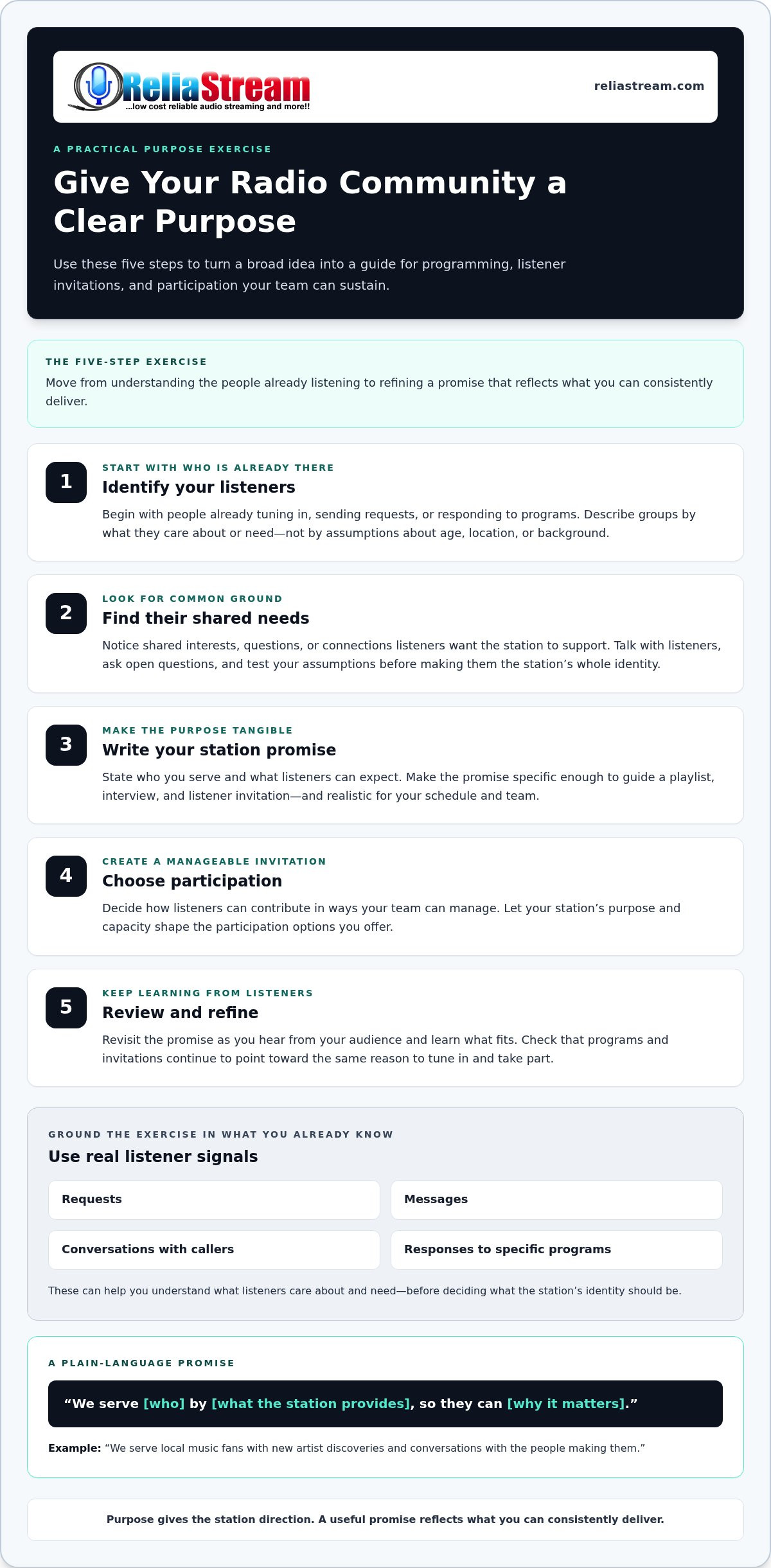
A community purpose should do more than sound good in a slogan. It should help your team decide what belongs on air, how hosts speak to listeners, and what kinds of contributions to invite. Use this five-step exercise to turn a broad idea into a practical guide for programming and participation.
- Identify your listeners. Start with people already tuning in, sending requests, or responding to programs.
- Find their shared needs. Look for common interests, questions, or connections they want the station to support.
- Write your station promise. State who you serve and what listeners can expect from you.
- Choose participation. Decide how listeners can contribute in ways your team can manage.
- Review and refine. Revisit the promise as you hear from your audience and learn what fits.
Identify the listeners and shared interests your station serves
Use evidence you already have: requests, messages, conversations with callers, and responses to specific programs. Describe listener groups by what they care about or need, rather than making assumptions about age, location, or background. A station might serve people seeking new independent music, neighbors who want useful local updates, or listeners looking for thoughtful discussion of a specialist subject. Talk with listeners directly, ask open questions, and test your assumptions before making them the station’s whole identity.
Turn your station’s purpose into a listener promise
Try this plain-language template: “We serve [who] by [what the station provides], so they can [why it matters].” For example: “We serve local music fans with new artist discoveries and conversations with the people making them.” Make the promise specific enough to guide a playlist, an interview, and a listener invitation, but realistic for your schedule and team. A useful promise reflects what you can consistently deliver.
A clear station promise keeps community-building consistent by helping every program and invitation point toward the same reason to tune in and take part. Hosts don’t need to recite it word for word. They can express it naturally in show introductions, social posts, interviews, and requests for listener input. Review those choices regularly and ask whether they match the promise. The National Federation of Community Broadcasters offers useful ideas for using audience data to build trust and serve listeners, which can help make that review more attentive and grounded.
Purpose gives the station direction; reliable access helps listeners return to hear it. As you put your promise into practice, explore internet radio hosting as one way to make your stream accessible to your audience.
You Don’t Need a Huge Audience to Build a Radio Station Community
A large audience can help a station reach more people, but it isn’t a prerequisite for meaningful connection. A small group that returns, contributes, and hears back can begin building a community around your radio station. Focus first on whether your team can create a welcoming exchange, not on how many people are listening.
Community radio can be understood through its relationship to the people it serves, rather than audience size alone. Britannica’s overview of community radio offers a useful point of reference for distinguishing community-oriented broadcasting from commercial and public radio. For your station, the practical question is: what can listeners contribute, and what can your team reliably do with that contribution?
Choose participation channels your team can maintain
Every invitation takes time to manage. Compare options by the effort required from your team and listeners, as well as the depth of connection each can support. These are starting points, not a checklist to complete:
- Song or topic requests: Low effort for both the team and listener. A host can acknowledge a selection on air and explain how requests are considered.
- Listener questions: Manageable for a small team and easy to submit in writing. Questions can guide a segment or give a host a focused prompt for discussion.
- Voice messages: More effort to review and prepare, but they let listeners contribute in their own words without joining a live call.
- Interviews or online conversations: Higher coordination and moderation needs. They can create a deeper exchange when the format and team capacity support them.
Choose one recurring invitation first, such as a weekly question tied to a show. Tell people where to send a response and when they might hear it discussed. A clear schedule sets expectations and helps prevent participation from becoming a stream of messages no one has time to handle.
Make participation easy, welcoming, and purposeful
Be specific about what you’re asking. “Tell us what local story deserves more attention” gives listeners a clearer starting point than “Get in touch.” Offer a written option for people who don’t want to speak on air, and explain whether a message may be read, edited, or used in a segment. Keep the prompt relevant to the program so contributions feel connected to the station, not collected for their own sake.
Close the loop. Thank contributors, let them know when an idea has influenced a show, and respond plainly when a submission can’t be included. You don’t need to feature every message, but you do need to treat each one with care. Start with one invitation your team can sustain, then adjust it based on what listeners actually use.
Create a Two-Way Feedback Loop That Keeps Listeners Connected
Asking for input is only half the job. Listeners need to see what happens next. A repeatable feedback loop helps your station show that contributions are heard, considered, and handled thoughtfully. Keep the cycle simple: invite input, review it, respond, act where appropriate, and report back.
Ask better questions and close the loop
Specific prompts make it easier for listeners to respond and for your team to use what they hear. Ask a question tied to an upcoming show, a local concern, or a shared interest. For example: “What question should we ask the neighborhood organizer in Friday’s interview?” Tell listeners where to send responses, who reviews them, and where they’ll hear the follow-up, such as on air or in a station update.
Not every suggestion will fit the schedule, format, or resources. Say so plainly. If a listener idea leads to a new segment, explain the connection. If it can’t be used, acknowledge the contribution and, when useful, give a brief reason. Consistent follow-through builds more trust than a flurry of requests followed by silence. For another perspective on listener access, see this guide to secure radio streaming.
Set community guidelines and protect trust
Make participation expectations easy to find. State that contributions should be respectful and relevant, explain that harmful or off-topic submissions may be moderated, and describe how listener messages might be used. Collect only the details you need to respond, and don’t share personal information on air without permission. Apply the same standards across messages, calls, and online discussions. If you remove a contribution, communicate calmly and consistently rather than singling someone out for public criticism.
Keep the feedback loop manageable. Track a few simple signals over time: whether people contribute again, which topics or questions recur, and whether listeners take part in station events. These aren’t proof of guaranteed loyalty or growth. They’re clues that can help your team spot what resonates, where an invitation needs to be clearer, and what deserves a thoughtful response. Set aside a regular time to review them, then share relevant decisions with listeners.
Trust also depends on being able to tune in when you say listeners can. If you’re strengthening stream access as part of that commitment, explore internet radio hosting options. Reliable access supports the relationship; listening and responding make it two-way.
Make Your Radio Station Community Easier to Find and Keep Joining
A listener can’t join in if they can’t find the show, stream, or invitation. Map the journey from first discovery to active participation, then remove obstacles at each step. Someone hears a clip, finds the schedule, tunes in, sees a clear prompt, and knows where to respond. Make that path obvious on your station website and the channels you already use.
Keep the essentials easy to spot: current show times, a working stream link, simple participation instructions, and a place to find follow-up. Check those details whenever the schedule or program changes. Building a community around your radio station depends on real relationships, but reliable access helps listeners return and pick up where they left off.
Connect on-air moments with online participation
Give listeners the same clear next step on air and afterward. A host might invite people to share a question during a discussion, then repeat where to send it before the segment ends. Add the prompt to the program page or show notes so listeners who hear the broadcast later can still take part. Keep the response destination consistent instead of sending people through a maze of accounts and links.
Access across devices can make it more convenient for listeners to tune in where they prefer. A station might use a web stream, smart-speaker access, or an app, depending on its audience and resources. Explore radio streaming app development as one way to extend access beyond a browser. The technology supports the listening journey; it doesn’t create the shared purpose or conversation for you.
Build a sustainable community rhythm
Make participation predictable without overloading the team. For example, invite one response during a regular show, review submissions at a set point in the week, and share a short follow-up in the next broadcast or program update. Choose a weekly or monthly rhythm your staff or volunteers can maintain. Review recurring questions and participation patterns at a consistent interval, then adjust the invitation if it isn’t clear or useful.
Start this week with a practical reset:
- Check that the schedule and stream are easy to locate.
- Choose one program and add one clear participation prompt.
- Set a time to review responses and share a follow-up.
- Ask a listener to test the path from finding the show to joining in.
For infrastructure that helps keep your station accessible, explore ReliaStream radio hosting and streaming solutions, including hosting and app options. Keep the invitation human and the route to the stream clear. Then make it easy to come back.
Start Building a Community One Connection at a Time
Building a community around your radio station doesn’t depend on a massive audience or a complicated plan. Give listeners a clear reason to gather, invite them to contribute in a way your team can sustain, and show them what happens with their input. Then make it easy to find the schedule, return to the stream, and join the conversation again.
Reliable access helps support that routine, but technology is only the delivery layer. ReliaStream offers ShoutCast and IceCast hosting with Centova Cast or MediaCP control panels. Its plans include Auto DJ and remote broadcasting, and custom apps and Alexa streaming skills can extend listening access across devices. The relationships still come from your station’s purpose and follow-through.
Ready to support consistent access for your listeners? Explore ReliaStream radio hosting and streaming solutions. Start with one meaningful invitation, keep listening, and let your community grow through the connections you build together.
Frequently Asked Questions
How do you build a community around a radio station?
Start by defining who your station serves and what listeners can expect from it. Then invite participation with a specific prompt, such as asking for song requests, questions for a guest, or stories about a local issue. Choose a response channel your team can manage, acknowledge contributions, and share what you did with the feedback. Building a community around your radio station takes consistent, genuine interaction, not a single promotional push.
Can a small radio station build an active community?
Yes. A small station can start with a focused group and one repeatable participation habit. For example, a host could ask one question during a regular program, collect replies through a familiar channel, and mention selected responses in a later broadcast. Keep the invitation welcoming and manageable for your team. A smaller scale can make it easier to recognize contributors and respond personally, without trying to copy a larger broadcaster’s approach.
What makes listeners feel connected to a radio station?
Listeners can feel connected when a station reflects interests they recognize and gives them a meaningful way to contribute. That might mean hearing relevant topics, submitting a question, or sharing a story that the station acknowledges. Follow-through matters: explain how input is considered and report back when it shapes a program or decision. Connection develops through repeated, respectful interactions, rather than occasional promotional posts or engagement campaigns.
How can a radio station get listener feedback?
Ask focused questions on air and provide a clear response route, such as a station email, website form, or moderated online channel. Tell listeners what kind of feedback would help and how their message might be used. Review responses regularly, note recurring themes, and share a relevant response or next step. Be honest about what you can act on. Listening well doesn’t require promising to adopt every suggestion.
What should a radio station community include?
There’s no fixed membership list or required set of activities. Depending on its purpose, a station community might include listeners, hosts, volunteers, contributors, local organizations, or people connected by a shared interest. Some may take part through live programs, while others prefer sharing stories, attending events, or joining an online discussion. Choose formats that suit your audience and team, and make participation expectations clear.
How do you keep a radio station community engaged over time?
Create a routine listeners can recognize: invite contributions, respond, share relevant programming, and follow up on decisions. Keep the schedule and participation details easy to find so people know when to tune in and how to join. Review listener responses and recurring themes at a regular interval. If an activity takes more effort than your team can sustain, simplify it or choose another format, while keeping expectations and community guidelines consistent.


