

What if the best way to earn from your station isn’t adding more ads, but choosing a revenue model that fits your listeners? Ads can bring in revenue, but too many may push listeners away. Memberships, sponsorships, and other options have different demands, too. The right commercial internet radio hosting setup can support reliable delivery and access, but it won’t guarantee earnings or make every strategy a fit.
It’s worth weighing audience expectations alongside the practical work of running a station. A niche music stream, a talk format, and a small team won’t necessarily benefit from the same approach. This guide compares revenue models so you can assess what suits your audience, format, and resources without assuming a guaranteed return.
Then we’ll connect those choices to hosting considerations, including stream quality, SSL-secured links, control-panel options, Auto DJ, remote broadcasting, and optional apps for reaching listeners on more platforms. You’ll see what each capability can support, what to check before committing, and why a smooth listening experience belongs in the revenue plan from the start.
Key Takeaways
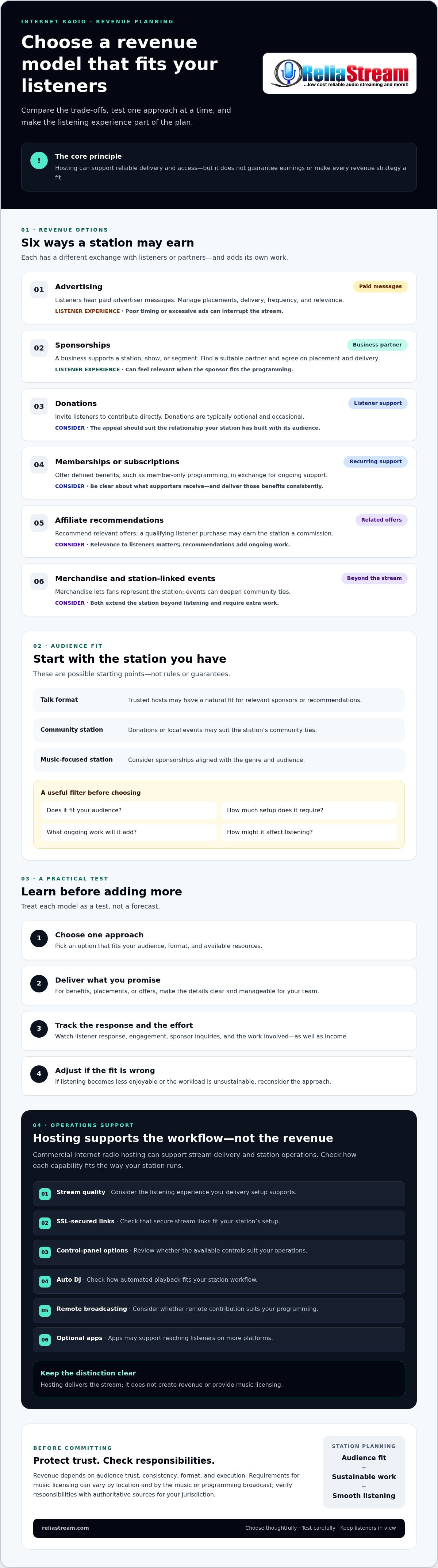
- Compare ads, sponsorships, donations, memberships, and affiliate offers by the effort they require and how they may land with listeners.
- Choose revenue options that fit your format and the kind of relationship you’ve built with your audience.
- Test one approach at a time, then track listener response, engagement, sponsor inquiries, and the work involved.
- Use commercial internet radio hosting capabilities to support your chosen workflow, while remembering that hosting delivers the stream, not the revenue.
- Check how SSL-secured links, Auto DJ, remote broadcasting, and control panels fit your station’s operations.
Internet radio station monetization strategies: where revenue can come from
A stream can attract listeners before you’ve worked out how to fund it. Building a station takes time, but an audience alone doesn’t automatically pay the bills. Monetization means earning income from the station, its audience, or related offerings. Start by understanding who listens and what they value, then test a revenue model that fits.
Internet radio combines online audio delivery with programming for broad or highly specific interests. That variety creates different ways to earn, from selling relevant audience attention to inviting listeners to support a station they care about. Options include advertising, sponsorships, donations, memberships or subscriptions, affiliate recommendations, merchandise, and station-linked events.
Audience fit determines which station revenue model is worth testing: choose an offer that feels relevant to listeners, not just convenient for the station.
Which revenue models can an internet radio station use?
Advertising and sponsorships bring in outside support in exchange for access to an audience. Advertising can involve individual spots or a more automated process. Sponsorships usually connect a business with a show, segment, or station identity. Both work best when the advertiser’s message makes sense for listeners. Poorly matched or frequent ads can disrupt the experience.
Listener-funded approaches ask the audience to contribute directly. Donations are typically optional and occasional, while memberships or subscriptions can offer recurring support in exchange for defined benefits, such as access to member-only programming. State what supporters receive and make sure you can deliver those benefits consistently.
Affiliate recommendations, branded merchandise, and station-linked events can extend the station beyond the stream. An affiliate offer may earn a commission when a listener makes a qualifying purchase. Merchandise gives fans a way to represent the station, while events can deepen community ties. Each adds work, and none guarantees income.
What should broadcasters weigh before monetizing?
Compare each option using four practical questions: Does it fit your audience? How much setup does it require? What ongoing work will it add? How might it affect listening? A talk station with trusted hosts may have a natural fit for relevant sponsors or recommendations. A community station might explore donations or local events. A music-focused station could consider sponsorships that align with its genre and audience. These are starting points, not rules.
Treat each model as a test, not a forecast. Revenue depends on audience trust, consistency, format, and execution, so don’t assume listener numbers translate into predictable earnings. Track audience response and workload as carefully as income. If an approach makes listening less enjoyable or demands more time than your team can sustain, adjust it.
One separate responsibility: hosting delivers the stream, but it doesn’t provide music licensing. Requirements can vary by location and the music or programming you broadcast. Verify applicable licensing responsibilities with authoritative sources for your jurisdiction before launching or changing your monetization plan.
How advertising, sponsorships, and listener support work for online radio
Revenue models aren’t interchangeable. Advertising sells space around programming, sponsorships build a direct relationship with a business, and listener support asks the audience to fund the station. Each can work, but the fit depends on your format, audience expectations, and capacity to manage the details. The Internet Radio Market Analysis offers broader context on market trends, including digital advertising and programmatic audio.
Use this comparison to narrow your options before committing. Setup and workload vary depending on how you manage each model.
| Model | Audience relationship | Setup and ongoing work | Listener experience |
|---|---|---|---|
| Advertising | Listeners hear paid messages from advertisers | Arrange ad delivery or placements; manage frequency and relevance | Can interrupt a stream if poorly timed or excessive |
| Sponsorship | A business supports a station, show, or segment | Find suitable partners and agree on placement and delivery | Can feel relevant when the sponsor fits the programming |
| Donations | Listeners choose whether to contribute | Explain how to support the station and manage contributions | Voluntary, with no required paid benefit |
| Memberships | Supporters contribute in exchange for defined benefits | Set up recurring offers and deliver promised perks | Can deepen connection, but benefits must be clear and sustainable |
| Affiliate offers | Listeners encounter recommended products or services | Select relevant offers and disclose commission relationships | Trust depends on honest, useful recommendations |
Are advertising and sponsorships right for every station?
Not automatically. An inserted ad is a paid message placed into a stream, while a direct sponsorship is an agreed partnership that might include a host-read mention or support for a particular program. In either case, potential partners will want to know whether your audience is relevant to their offer and whether you can deliver what you agree to.
Set expectations before a campaign starts: where messages appear, how often they run, what the sponsor receives, and how paid content will be disclosed to listeners. A local sports show, for example, might approach a business connected to its community, while a narrowly focused music station may be more compelling to a genre-aligned partner. Don’t promise audience reach or results you can’t verify.
Can listener support and affiliate offers complement ads?
Yes, if the offer respects the relationship you’ve built. Donations invite voluntary support; memberships add a defined exchange, such as access to extra programming, but create ongoing delivery work. Affiliate links may earn a commission when listeners take an eligible action. Disclose that connection clearly and recommend only offers that make sense for your audience. Consider trust, administration, and the value listeners receive, not just potential income.
Once your model and delivery needs are clearer, you can explore internet radio hosting options that fit your station’s workflow. Commercial internet radio hosting supports stream delivery; it doesn’t sell ads or guarantee revenue.
Match a station monetization strategy to its audience and format
A revenue idea can look strong on paper and still feel wrong on air. Start with the audience’s connection to the station, then weigh sponsor fit, management effort, and whether the approach interrupts or adds value to listening. A loyal niche audience may care more about a relevant offer than a broad, generic message, but loyalty alone doesn’t guarantee commercial success.
How do station format and audience affect monetization fit?
Use these examples as ideas to test, not rules. The same format can attract different listeners, so validate what your own audience welcomes.
| Station format | Possible fit to explore | What to weigh |
|---|---|---|
| Music | Genre-aligned sponsors or listener memberships | Ad frequency and whether benefits suit the listening experience |
| Talk | Show sponsors or relevant affiliate recommendations | Host workload and clear disclosure of paid relationships |
| Sports | Local or sports-related sponsors | Whether the partner is relevant to the listeners and programming |
| Community | Donations, local sponsorships, or station-linked events | Time needed to coordinate partners, supporters, and events |
| Niche | Specialist sponsors, merchandise, or memberships | Relevance and value may matter more than broad reach |
Pick one suitable approach first. Define a manageable test, then review listener feedback, engagement, sponsor interest, and the workload it creates before adding another revenue stream. This keeps the station experience in view instead of layering on offers simply because they’re available.
When can apps and listener platforms support station growth?
Listening access matters when your audience wants to tune in beyond a station website or player. Apps for Roku, Google TV, Amazon Fire TV, and Alexa can provide additional ways to reach a stream. They may make listening more convenient, but an app doesn’t automatically create an audience or generate revenue. Consider whether your listeners use those platforms and whether your team can support the app experience. For platform-specific considerations, see radio streaming app development.
Technical choices should support the way you plan to broadcast and manage the station, not dictate the revenue model. Compare ShoutCast and IceCast as you assess which streaming platform fits your workflow. Commercial internet radio hosting can support stream delivery, while audience fit, offer design, and consistent execution remain the broadcaster’s work.
A practical plan for testing internet radio monetization strategies
A small, structured test can show whether a revenue idea fits your station before you build it into every show. Set a clear question, choose one approach, and review both audience response and the work it takes to maintain. Treat the results as evidence for your next decision, not as a promise of future income.
What should a broadcaster measure during a monetization test?
Where possible, use the same observation period and tracking approach before and after a change. Numbers can help spot patterns, but they aren’t guaranteed predictors of revenue. Record listener feedback alongside engagement and practical effort.
- 1. Understand your audience. Note which programs draw engagement, what listeners respond to, and what they say they value. Use that context to choose an offer that belongs with your format.
- 2. Check the operating requirements. List the tools, staff time, and recurring tasks involved. As you review hosting and other operating needs, use this budget internet radio hosting guide as a reference.
- 3. Verify obligations before launch. Check applicable music rights, advertising and disclosure rules, privacy requirements, contracts, and any platform requirements for the places where you broadcast or promote the offer. Requirements can vary by location; confirm them with authoritative sources or qualified advisers.
- 4. Run one limited test. Define the placement, frequency, offer, and duration in advance. Keep the scope manageable so you can identify what listeners are reacting to.
- 5. Review and decide. Track audience response, engagement, sponsor inquiries, and administrative effort. Compare listener feedback and available retention signals before and after the change, then keep, adjust, or stop the approach.
How can stations protect listener trust while earning revenue?
Be direct about commercial relationships. Clearly label paid promotions, sponsorships, and affiliate recommendations so listeners can tell when a message is supported by a business or could earn the station a commission. Agree with partners on placement and delivery, and keep promotions relevant to the audience.
Pay attention to the listening experience, too. If listeners object to an interruption or engagement signals weaken after a change, review the timing, frequency, or format. You don’t have to abandon monetization, but be ready to refine or stop a tactic that undermines the programming people came to hear.
Once you’ve mapped the workflow, explore commercial internet radio hosting options that align with your station’s delivery needs. Hosting supports the stream; your test results and audience relationships guide the revenue decisions.
How commercial internet radio hosting supports a monetized station
Hosting is the delivery layer, not the business model. It carries your station’s audio to listeners, but it doesn’t sell ads, find sponsors, or guarantee station revenue. Dependable stream delivery can support a monetization plan by helping listeners access the programming, but it can’t create demand or income on its own.
ReliaStream provides ShoutCast and IceCast hosting, with Centova Cast or MediaCP control-panel options. The right setup depends on how your station operates. Auto DJ can support scheduled programming when you’re not broadcasting live, while remote broadcasting can suit shows presented from another location. Confirm which capabilities are available with the plan you’re considering.
Which hosting capabilities matter when a station earns revenue?
- Auto DJ and remote broadcasting: Consider how each fits your schedule, live shows, and transitions between programming. They can support different workflows, but don’t replace the need to plan what listeners hear and when.
- SSL-secured stream links: Check whether your website, player, and other listening destinations support the link you’ll use. SSL is a secure-delivery consideration; it doesn’t guarantee stream availability or resolve every compatibility issue.
- Control panels: Compare how Centova Cast and MediaCP fit your day-to-day station management. Focus on the tasks your team needs to handle, such as managing programming and broadcasting, rather than choosing based on a feature list alone.
These capabilities support delivery and operations. They don’t determine whether ads, memberships, or sponsorships will suit your audience.
What should a broadcaster check before choosing a host?
Start with listener demand and the listening experience you want to provide. Then consider your stream bitrate needs, broadcast workflow, and plans for future growth. ReliaStream’s hosting options range from 32 Kbps to 320 Kbps; the appropriate choice depends on your station’s requirements and the capabilities of listeners’ connections and devices. Confirm the current features of any plan before selecting it, especially if Auto DJ, remote broadcasting, or a particular control panel is important to your setup.
Also check supported integrations and listening destinations, and make sure the setup fits the way you intend to reach your audience. Commercial internet radio hosting can provide the technical foundation for a station’s chosen revenue approach, but the strategy and its results remain yours to evaluate.
Explore ReliaStream commercial radio hosting and match hosting features to your station’s next step.
Build a revenue plan that fits your station
The strongest monetization plan starts with your listeners, not a revenue trend. Choose an option that fits your format and the relationship you’ve built, then test it on a manageable scale. Watch audience response and workload together, and adjust if the experience starts to feel less valuable to listeners.
Commercial internet radio hosting supports delivery, not earnings. It can help put your programming in front of listeners while you develop and evaluate your revenue approach. ReliaStream is an independent provider established in 2008, offering ShoutCast and IceCast hosting with Centova Cast or MediaCP options. Custom apps for Roku, Google TV, Amazon Fire TV, and Alexa can provide additional listening access, though they don’t guarantee audience growth or income.
Ready to align your station’s setup with its next step? Explore ReliaStream commercial radio hosting and review the hosting options that fit your workflow. Start with a clear plan, stay close to your audience, and build from what you learn.
Frequently Asked Questions
How can an internet radio station make money?
An internet radio station can earn money through advertising, sponsorships, listener donations, paid memberships, affiliate recommendations, merchandise, or station-linked events. The best fit depends on the format, audience relationship, and time available to manage each option. For example, a community station might test local sponsorships or voluntary contributions, while a specialist talk show could consider relevant affiliate offers. None of these models guarantees income, so test carefully and monitor listener response.
Can a small internet radio station get sponsors?
Yes, a small station can approach sponsors if it can explain who listens and why the audience fits a potential partner. A focused station may offer a clear connection to a particular interest or community, even without broad reach. Start with businesses whose products or services relate naturally to the programming. Agree in advance on placement, frequency, and disclosure, and avoid promising audience size or campaign results you can’t verify.
How do internet radio stations earn advertising revenue?
Stations earn advertising revenue by selling placements for paid messages in or around their programming. Ads may be inserted into a stream or presented by a host, while programmatic systems can automate buying and placement when available. Earnings depend on factors such as advertiser demand, audience relevance, and the arrangement in place, so there’s no guaranteed return. Set clear expectations for ad frequency and placement to protect the listening experience.
Do internet radio stations need a large audience to monetize?
No, a large audience isn’t the only possible basis for monetization. A smaller station may explore sponsorships aimed at a well-defined community, voluntary listener support, or a relevant affiliate recommendation. What matters is whether the offer makes sense to listeners and whether the station can manage it consistently. Audience size alone doesn’t predict results. Test one suitable approach, then review listener feedback, engagement, inquiries, and administrative effort.
Does commercial internet radio hosting include music licensing?
No. Commercial internet radio hosting delivers the stream; it doesn’t provide music licensing. Broadcasters are responsible for checking which music rights and permissions apply to their station, the content they play, and the places where they operate or make the stream available. Requirements can vary by jurisdiction and use. Verify current obligations with authoritative sources or a qualified adviser before broadcasting. ReliaStream provides ShoutCast and IceCast hosting, not music royalty licensing.
Can an internet radio app generate revenue for a station?
An app can make a station easier to access, but the app itself doesn’t automatically generate income. Revenue would depend on a separate model, such as sponsorships or listener support, and on how that offer is implemented and disclosed. ReliaStream develops custom radio apps for Roku, Google TV, Amazon Fire TV, and Alexa. Consider whether listeners use those platforms and what ongoing work the app and its revenue approach would require.


