

Your station's heartbeat isn't the music; it's the server. What's the point of a killer playlist if your listeners are met with dead air? You've spent weeks curating the perfect vibe. Then, the buffering starts. The drop-offs happen. Your audience vanishes. It's a nightmare for any serious creator. Finding reliable internet radio hosting shouldn't be a game of chance. You need a rock-solid connection that stays live 24/7. High bitrates. ZERO lag. Total professional reliability for a global audience that expects the best.
Stop settling for "good enough" tech that holds your growth hostage. You want 100% uptime and crystal clear 320 Kbps bitrates without the technical headache. We're showing you exactly how to choose a hosting partner that delivers professional results and easy Auto DJ management. Discover how to ditch the lag, secure your stream with SSL, and scale your brand onto major platforms like Roku and Alexa. This is the year you stop worrying about the "how" and start focusing on the "show." Let's build a station that NEVER sleeps.
Key Takeaways
- Learn why high-bandwidth Tier 1 networks are the secret to preventing buffering and maintaining professional 24/7 uptime.
- Discover how reliable internet radio hosting uses Auto DJ and panels like MediaCP to act as an insurance policy for your station.
- Master the differences between ShoutCast and IceCast. Ensure your stream handles listener spikes without breaking a sweat.
- Find the perfect balance between 320 Kbps high-fidelity audio and adaptive bitrates for listeners on any device.
- Scale your reach beyond the web. Launch custom apps on Roku, Amazon Fire TV, and Alexa to dominate the living room audience.
What Defines Reliable Internet Radio Hosting in 2026?
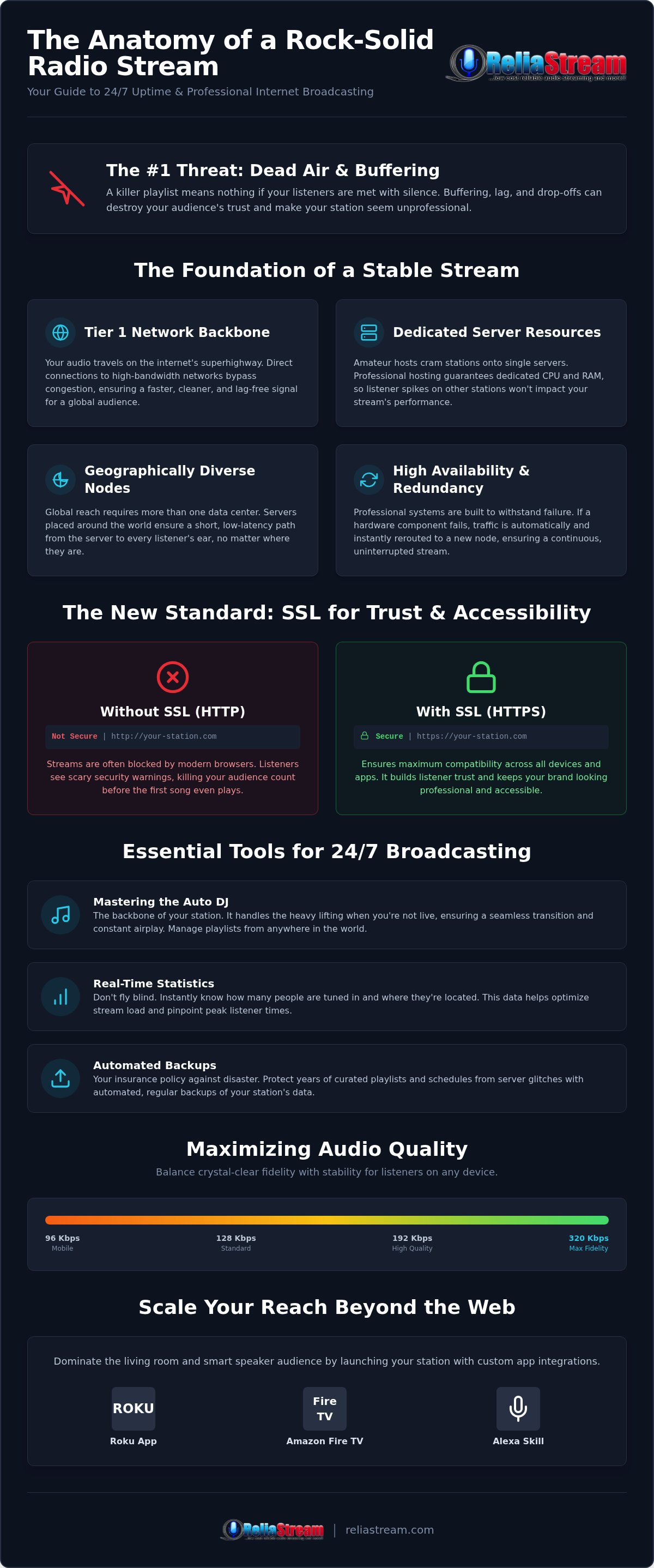
Uptime is a cheap promise. Most providers throw around "99.9% uptime" like it's a guaranteed win. It isn't. In the world of professional broadcasting, that 0.1% of downtime represents hours of dead air and thousands of lost listeners. Real reliable internet radio hosting is about the infrastructure under the hood. It starts with Tier 1 network providers. These are the high-bandwidth giants that form the internet's backbone. When your hosting partner connects directly to these networks, you bypass the congested "budget" routes that cause buffering. Your audio travels faster. It stays cleaner. It reaches your audience without the stutter.
Server-side processing is the next hurdle. Pushing a high-fidelity 320 Kbps stream requires serious CPU and RAM. Amateur hosts often oversubscribe their hardware, cramming too many stations onto a single server. When one station spikes, everyone else suffers. You need dedicated resources. You need redundancy. If a single hardware node fails, a professional system should shift your stream to a new node instantly. Whether you utilize Icecast or the Shoutcast streaming protocol, the hardware must be robust enough to handle the heavy lifting of modern digital audio.
The Core Components of a Stable Stream
Global reach demands more than a local data center. If your server is in a basement in one city, your listeners on the other side of the planet will struggle with latency. A professional backbone uses geographically diverse nodes to ensure a short path from the server to the ear. Don't settle for shared hosting environments designed for websites. Radio is a different beast. It requires constant, sustained data throughput. High Availability is the infrastructure's ability to maintain a continuous, uninterrupted stream by automatically rerouting traffic if a hardware component fails.
Why SSL is the New Standard for Reliability
Security isn't an optional add-on anymore. It's a requirement for staying on the air. Modern web browsers are aggressive. If you provide a non-secure HTTP link, browsers like Chrome and Safari will often block the stream entirely or show terrifying "Not Secure" warnings. This kills your listener count before the first song even plays. Security is a trust signal. It tells your audience that their connection is safe. Integrating ssl radio streaming ensures maximum compatibility across all devices, apps, and browsers. It keeps your station accessible. It keeps your brand professional. Stop letting outdated links stand in the way of your growth.
Essential Features for Uninterrupted 24/7 Broadcasting
Dead air kills stations. Period. Your listeners don't care if your local ISP is having a bad day or if your laptop decided to update at 3 AM. They want your content. This is where reliable internet radio hosting steps in to save your reputation. Redundancy is the secret sauce here. You need tools that act as an insurance policy for your stream. It's about professional standards. While FCC regulations for online streams are largely absent for web-only radio, your audience still expects a polished, broadcast-quality experience that never falters.
This requirement for reliability extends to other professional fields; for example, medical practitioners use ClicFone to maintain constant telephone availability, ensuring their patients always reach a professional responder.
Real-time statistics are your radar. You can't fly blind in 2026. You need to know exactly how many people are tuned in and where they are located. This data helps you optimize your stream load and understand peak listener times. Combine this with automated backups, and you've got a fortress. Imagine losing five years of curated playlists because of a server glitch. It's a nightmare. Professional hosting ensures your library and schedules are always safe and ready for recovery.
Mastering the Auto DJ for Constant Airplay
The Auto DJ is your station's backbone. It handles the heavy lifting when you aren't live. Moving from a live broadcast to the Auto DJ should be seamless. No hiccups. No silence. With cloud-based library management, you can upload your tracks and manage your rotation from anywhere in the world. Whether you're in a home studio or a coffee shop, you have total control. Scheduling for a global audience is just as easy. You can set specific playlists for different time zones, ensuring your morning show hits New York and London at the perfect time. If you're just starting, checking out a professional hosting solution can give you the edge you need.
Centova Cast vs. MediaCP: Which Panel Wins?
Your control panel is the brains of the operation. Centova Cast is the industry veteran. It's rock-solid, straightforward, and perfect for pure audio playlisting. MediaCP is the modern powerhouse. It offers a slicker user interface and better support for video-audio hybrid streams. Choosing between them depends on your workflow. Do you want the tried-and-true stability of Centova, or the feature-rich flexibility of MediaCP? Both provide the stability required for a high-traffic station. Before you commit, make sure you've gone through our internet radio station setup checklist to ensure your configuration is optimized for 24/7 uptime.
Choosing Your Protocol: ShoutCast vs. IceCast Reliability
Which protocol holds up when the traffic hits? It's the question every broadcaster asks before going live. Both ShoutCast and IceCast are industry titans. They've survived decades of digital evolution for one reason: they work. But they handle the technical approaches to internet broadcasting with different philosophies. When you invest in reliable internet radio hosting, the protocol choice becomes a strategic move for your brand. You need a setup that handles listener spikes without breaking a sweat. No lag. No stutter. Just pure audio delivery.
Compatibility is the silent killer of great stations. You need to know that your existing hardware and encoding software play nice with your chosen server. Most modern encoders support both, but the way they manage metadata and directory listings varies. If you want to be discovered on platforms like TuneIn or the ShoutCast directory, your protocol choice matters. It's about being where the listeners are.
The Case for ShoutCast Hosting
ShoutCast is the veteran. It has a legacy of professional performance that's hard to beat. It's stable. It's familiar. It remains the pro choice for broadcasters who want a straightforward, high-impact presence. Choosing shoutcast server hosting gives you an immediate edge with the ShoutCast Yellow Pages. This built-in discovery tool puts your station in front of a massive, pre-existing audience. The ShoutCast Advantage is simple: it's a plug-and-play powerhouse that turns a local stream into a global brand with minimal fuss.
The Case for IceCast Hosting
Looking for total control? IceCast is your answer. It's open-source. It's flexible. It's built for efficiency. The primary draw is the ability to use "mount points." This allows you to run multiple streams at different bitrates from the same server. Searching for the best icecast hosting provider means finding a partner that can support this level of customization. IceCast is incredibly efficient with server resources, making it a top contender for stations planning to scale rapidly. If you're still undecided, check out our shoutcast vs icecast comparison for a deep technical breakdown.
The "can-do" verdict is clear. Both protocols are rock-solid. If your host provides the bandwidth and the hardware, you can't go wrong. Reliable internet radio hosting isn't just about the software; it's about the backbone supporting it. Pick the protocol that fits your workflow. Let the servers handle the rest.
Maximizing Audio Quality without Sacrificing Stream Stability
High audio quality is useless if the stream keeps cutting out. It's the ultimate balancing act for any broadcaster. You want that rich, deep sound that keeps listeners hooked, but you can't risk the dreaded buffering wheel. Reliable internet radio hosting isn't just about pushing the highest numbers; it's about smart delivery. When you push a 320 Kbps stream, you're demanding a lot from your listener's connection. If they're on patchy mobile data, they'll hit a wall of silence. You need a strategy that balances the "wow" factor with actual accessibility.
Don't ignore audio processing. Using Digital Signal Processors (DSPs) and levelers ensures your station sounds consistent. No one wants to jump from a quiet acoustic track to a deafeningly loud DJ. Professional sound requires professional tools. Latency is another silent killer. If you're running live call-in shows or play-by-play sports, a 30-second "radio lag" makes interaction impossible. Reducing this delay requires a host with a high-speed backbone and optimized server configurations. Get the tech right, and the audience will follow.
Bitrate Selection for Different Content Types
Content dictates your bitrate. Music stations should live in the 128 Kbps to 320 Kbps range to capture every detail. Audiophiles can tell the difference. However, if you're running a talk or news station, pushing 320 Kbps is a waste of resources. You can drop down to 32 Kbps or 64 Kbps and still sound crystal clear. This saves bandwidth and ensures your stream is rock-solid even for listeners on slow connections. SSL plays a huge role here too. It maintains stream integrity at high bitrates by ensuring the connection between the server and the listener remains secure and uninterrupted.
Optimizing Your Encoder for Reliability
Your encoder is the bridge between your studio and the world. Software encoders are flexible and cost-effective, but hardware encoders are the gold standard for pure, unshakeable stability. Whatever you choose, keep your settings simple. Match your sample rates to your source material. Usually, 44.1kHz is the sweet spot. Are you hearing choppy audio? It's usually an upload speed issue at the source. Test your connection before you go live. Troubleshooting these "choppy" issues before they reach the listener is what separates the amateurs from the pros. Ready to sound professional? Check out our high-bitrate hosting plans today and take your sound to the next level.
Scaling Your Reach with Reliable Custom App Integration
Think your website is the finish line? Think again. In 2026, the real growth isn't happening on desktops. It's happening in the living room. People want to listen while they cook, clean, or relax on the couch. If you're only on the web, you're invisible to the fastest growing segment of the market. Scaling your reach means moving beyond the browser. It means getting your station onto the devices your audience uses every single day. You need to be where they are.
This is where reliable internet radio hosting proves its worth. These third party platforms don't just find your stream by accident. They connect via API. They require a rock-solid, high-performance backbone that won't buckle when an app-based listener spike hits. You need a host that understands the technical demands of Roku, Amazon Fire TV, and Alexa. Don't let a weak server be the reason your station gets rejected from the big screen. Professionalism isn't just about the audio; it's about the delivery.
Dominating the Smart Home Market
Voice is the king of the kitchen. Alexa Skills have transformed how people discover and consume audio. It's fast. It's frictionless. "Alexa, play my station" is the new way of tuning the dial. If you aren't there, you're losing out to the competition. Google TV integration offers another massive opportunity. It puts your brand right alongside the biggest streaming services in the world. Modernizing your approach with radio streaming app development is no longer a luxury. It's a survival tactic for serious broadcasters who want to stay relevant.
The Technical Bridge: Server to Smart App
Here's the technical reality: Roku and Fire TV don't play nice with insecure links. Your stream MUST be SSL-compliant. We've mentioned browser warnings before, but for smart apps, it's a hard "no." If your link isn't secure, the app simply won't work. This is why reliable internet radio hosting must include native SSL support as standard. You also need a server that handles high-volume traffic without flinching. When you launch a custom app, your listener count can skyrocket overnight. Your infrastructure needs to be ready for the surge. It's time to stop thinking small. Modernize your station. Launch your custom apps. Take over the living room and let your voice be heard everywhere.
Take Control of Your Airwaves and Dominate the Dial
You've got the talent. You've got the vision. Now, you need the backbone to support it. Professional broadcasting in 2026 isn't just about the music. It's about the infrastructure. From mastering the bitrate balance to reaching listeners on their big screens, your hosting choice defines your success. Don't let buffering or insecure links pull the plug on your growth. You've worked too hard to let technical glitches stand in your way. It's time to build a station that stays live, no matter what.
Choosing reliable internet radio hosting is about long-term peace of mind. You need a veteran who has seen the industry evolve and knows how to navigate the technical hurdles. We've been serving broadcasters since 2008. We understand that stability is non-negotiable. Every plan we offer includes SSL Radio Links to keep your stream accessible on every modern browser. We're here to help you scale. Our custom app development for Roku and Alexa puts your voice in every smart home. The future of radio is voice-activated and app-driven. Your audience is waiting. Let's get you on the air and keep you there.
Ready for 100% Uptime? Start Your Professional Radio Stream with ReliaStream Now!
Frequently Asked Questions
What makes internet radio hosting truly 'reliable'?
True reliability is built on high-bandwidth Tier 1 networks and dedicated server resources. It's not just a percentage on a sales page; it's the ability to handle massive listener spikes without the stream stuttering. Reliable internet radio hosting requires a provider with a proven track record of maintaining hardware redundancy so that your station never goes dark. It's about the backbone supporting your creative vision.
Can I switch between ShoutCast and IceCast later?
Yes, you can switch, but it typically involves a fresh server setup. Since ShoutCast and IceCast use different technical configurations, you'll need to re-configure your encoder and update your stream links. It's best to choose the protocol that fits your directory needs from day one. This avoids the headache of re-submitting your station to platforms like TuneIn or the ShoutCast directory later on.
Do I need a special server for 320 Kbps audio quality?
High-fidelity audio demands high-performance hardware. Pushing a 320 Kbps Hosting Plan requires a server with enough CPU power and bandwidth to sustain that data throughput for every single listener. Standard "budget" servers often choke under this load. If you want audiophile quality, ensure your host provides dedicated resources specifically optimized for high-bitrate streaming. Don't settle for less when sound is your brand.
How does the Auto DJ feature prevent my station from going offline?
Auto DJ acts as your fail-safe. If your home internet drops or your encoding software crashes, the server takes over playback instantly. It plays your uploaded library directly from the cloud data center. This ensures your audience hears music instead of silence, keeping your 24/7 uptime intact while you troubleshoot your local connection. It's the ultimate insurance policy for professional broadcasters who can't afford dead air.
Is SSL streaming really necessary for my radio station in 2026?
Absolute necessity. In 2026, modern browsers and mobile apps will block non-secure links or flag them with "Not Secure" warnings. This kills your listener trust and SEO ranking instantly. Every professional station needs an SSL Radio Link to ensure the stream plays flawlessly across Chrome, Safari, and all major smart devices. If you want to be heard, you have to be secure. No excuses.
How do I get my radio station on Alexa and Roku?
You need custom app development to bridge the gap between your server and the smart home. This involves creating an Alexa Streaming App or a Roku Radio App that connects to your stream via API. It's the most effective way to move beyond the browser and dominate the living room market. Get your station where your listeners are actually spending their time. Voice and TV are the future.
What happens to my stream if my home internet goes out?
Your stream stays live. Thanks to reliable internet radio hosting and the Auto DJ feature, the server doesn't care if your local house loses power. It continues to broadcast your scheduled playlists from the data center without a hiccup. Your listeners won't even know you're offline. Once your local connection returns, you can simply reconnect and resume your live broadcast seamlessly. Total peace of mind.
Can I host a talk radio show with low bitrate plans?
Definitely. Talk radio doesn't need the massive frequency range of a symphony. A 32 Kbps Hosting Plan or 64 Kbps Hosting Plan is perfect for spoken word content. It provides crystal clear voice quality while using less bandwidth. This makes your station more accessible to listeners on slow mobile data connections. You get professional results without wasting resources on bitrates your content doesn't actually require.


