

A free trial can show you the controls, but it won’t tell you whether a stream fits your station’s audience and programming. Trial availability depends on the host, so look beyond the trial and compare the essentials: listener capacity, streaming format, and the support your setup needs.
Choosing reliable Shoutcast hosting for small stations means matching the stream to the way you broadcast. A DJ needs room for live sets and scheduled playlists; a church may prioritize clear, dependable services; a school may need a straightforward way to share announcements and events. The right fit should work for your real listening patterns, not just sound impressive on a plan page.
This guide helps you compare hosting options by listener capacity and format, then weigh practical differences for DJs, churches, and schools. You’ll see how bitrate choices affect compatibility and what to consider as your audience grows. Use clear criteria to choose a better-fit stream and take a confident next step.
Key Takeaways
- Compare plans by concurrent listener capacity and bandwidth, not just the headline bitrate.
- Use 64-128 kbps as a starting point when broad mobile compatibility matters.
- Match the streaming format and hosting setup to how DJs, churches, or schools deliver their programming.
- Consider how your station may grow, then choose a bitrate plan that fits its current audience and broadcast needs.
What is the best Shoutcast hosting for internet radio?
The right fit balances stream quality, listener capacity, format, and plan cost with how your radio station broadcasts. In the US, Shoutcast hosting carries the stream but does not grant music-use rights or settle royalties. Stations that play music need to address applicable permissions separately.
Hosting Plans and Starting Prices
Compare hosting plans by what the starting price includes, not by the headline alone. Listener capacity, bitrate, streaming format, and management features all affect whether a plan fits your station. A lower starting point may suit a modest stream, while a higher-capacity option can better support audience growth. For hosted radio, cost depends on the case and is given after a quote request; relevant factors include bitrate, capacity, and included features.
Radio Plan Price Comparisons
Radio plan prices are easier to compare when you line up the same criteria across options. Check how each plan handles simultaneous listeners, the stream’s bitrate and format, and whether features such as AutoDJ or SSL streaming are included. These differences matter more than a price label alone. For broad mobile compatibility, 64-128 kbps is a useful bitrate range to consider.
| Option | Best fit | Comparison criterion |
|---|---|---|
| 32 kbps stream | Lower-bitrate listening | Bitrate |
| 64 kbps stream | Talk programming | Bitrate |
| 128 kbps stream | Music programming | Bitrate |
| 320 kbps stream | Higher-bitrate audio | Bitrate |
| MP3 format | Broad device support | Compatibility |
| AAC Plus format | Quality at lower bitrates | Audio efficiency |
| SSL streaming | Secure listener connections | Browser compatibility |
| AutoDJ playback | Scheduled playlists | Programming needs |
| Live broadcasting | Presenter-led shows | Broadcast workflow |
Choose a plan that meets your audience and programming needs without paying for capacity or features your station won’t use.
Listener capacity and scalability
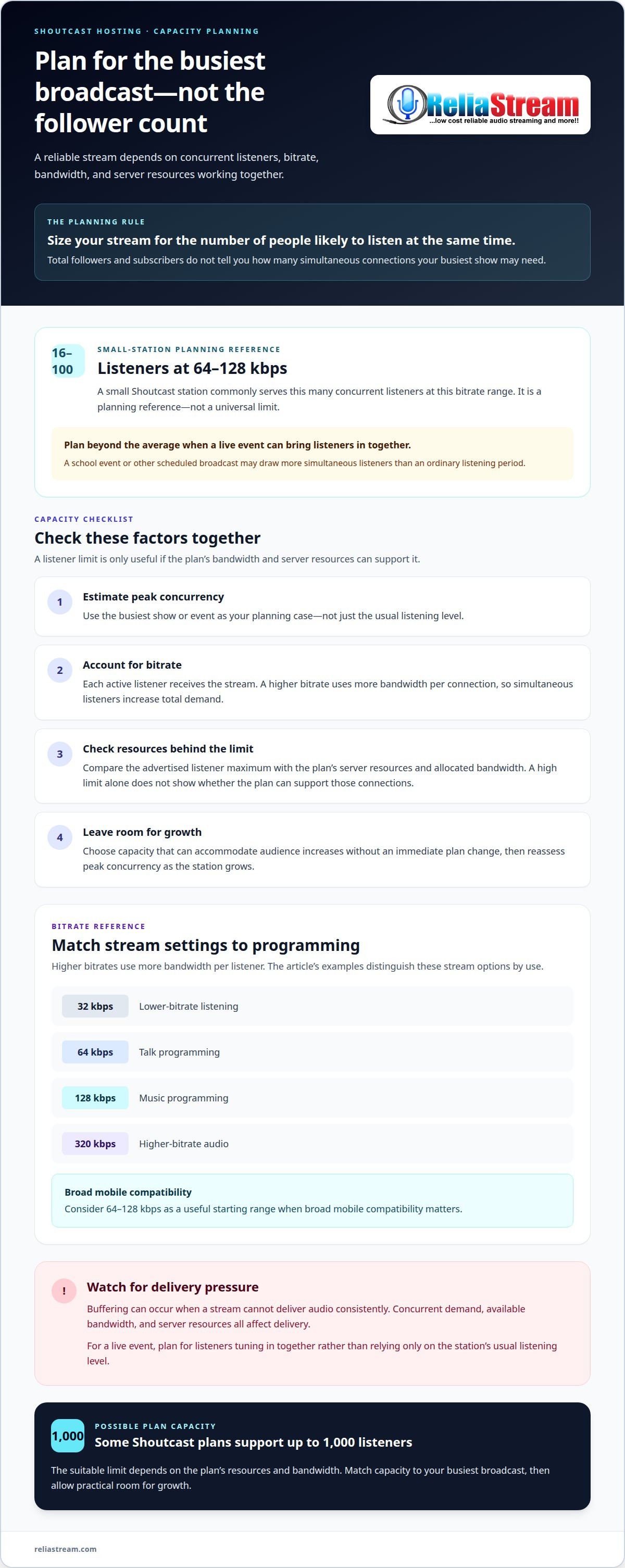
Choose capacity around concurrent listeners, not total followers or subscribers. A small Shoutcast station commonly serves 16-100 listeners at 64-128 kbps. That range is a planning reference, not a universal limit: a live event can draw more listeners at once than an average broadcast.
Each active listener receives the stream, so simultaneous connections increase bandwidth demand. Higher bitrates also use more bandwidth per listener. A station expecting a large audience during a scheduled broadcast, for example, needs more capacity than one whose audience listens at different times.
- Estimate peak concurrency: Use the busiest show or event as your planning case.
- Account for stream bitrate: A higher-quality stream increases bandwidth use per connection.
- Allow room for growth: Choose capacity that can accommodate audience increases without immediate plan changes.
Capacity depends on the plan, server resources, and bandwidth allocation. These factors work together: a high listener limit is useful only when the server and allocated bandwidth can support the connections. Consider an advertised maximum alongside the plan’s resource allocation, rather than treating it as a standalone measure.
Buffering can occur when a stream cannot deliver audio consistently. Concurrent demand, available bandwidth, and server resources all affect delivery. A station streaming a live school event, for example, should plan for listeners tuning in together rather than relying only on its usual listening level.
As an audience grows, reassess peak concurrency and stream settings before choosing more capacity. Shoutcast plans can support up to 1,000 listeners, but the suitable limit depends on the plan’s resources and bandwidth. Match capacity to your busiest broadcast, then leave practical room for growth.
Shoutcast and Icecast hosting
Shoutcast and Icecast both serve internet radio streams, while traditional web hosting stores website files. Uptime commitments, monitoring, and support vary by host; compare the stated service terms rather than assuming every plan includes the same protections.
Shoutcast Hosting
Shoutcast hosting is built for live audio broadcasts, with Auto DJ supporting scheduled playlists and prerecorded programming. A radio control panel can bring daily tasks together, including media uploads, playlists, broadcaster accounts, stream settings, listener statistics, and program schedules. This radio-focused setup suits stations that combine presenter-led shows with automated playback.
Icecast is another streaming-server option for internet radio. Compare it with Shoutcast by checking which server software fits your existing encoder, player links, and broadcasting workflow. A station already using Shoutcast may prioritize continuity, while a broadcaster comparing platforms may value compatibility with its planned listening apps.
Wowza-style platforms are another category to consider. Focus on the use case: live audio radio, scheduled Auto DJ content, or broader streaming needs. Don’t assume a platform designed for broader streaming will match a radio host’s control-panel workflow. Compare server software, stream format, playlist management, and listener statistics together.
Uptime Monitoring and Support
Monitoring can help identify stream interruptions, while support can assist with configuration or migration. These are separate considerations: monitoring describes how service status is observed, and support describes the help available when a problem arises. Compare the uptime commitment, monitoring scope, and support terms as distinct features. No single guarantee or support arrangement applies across all Shoutcast hosts.
For a station moving from another host, migration assistance may cover playlist transfers and stream configuration. Confirm that those tasks match the station’s setup, including its AutoDJ schedule and broadcaster accounts. The best platform is the one whose server software and management tools fit the station’s actual broadcast workflow.
Choosing hosting for DJs, churches, and schools
Security, backups, and outages affect every station differently. SSL streaming secures listener connections, while separate copies of playlists and audio can help preserve programming if files are lost. An outage can interrupt a DJ’s live set, a church service, or a school announcement, so understand the backup and monitoring arrangements included with your hosting.
Start with the broadcast schedule. A DJ running live sets needs a stream that supports live broadcasting alongside scheduled Auto DJ playlists. A church may prioritize consistent access during services, while a school may focus on announcements and recorded programs. Choose hosting for the station’s actual schedule, not a generic plan label.
Next, match capacity to the audience expected during the busiest program. A school assembly streamed to many listeners at once has different demands from recorded announcements played at separate times. Listener limits depend on plan capacity, server resources, and bandwidth allocation. These limits matter most when an event brings a concentrated audience.
- DJs: Consider live broadcasts, AutoDJ scheduling, and playlist management.
- Churches: Prioritize service schedules, stream access, and outage response arrangements.
- Schools: Consider event audiences, recorded content, and straightforward program management.
Consider security separately. SSL streaming secures connections between the stream and listeners and can improve browser compatibility. For each format and listening channel, consider whether the stream link suits the audience’s devices. A school sharing a stream through a browser, for example, can use a secure link.
Backup planning should cover both media and station settings. Playlists, recorded programs, and schedules represent different pieces of a station’s output. Understand how recovery procedures address those items, rather than treating “backup” as one broad feature. For outage planning, identify who monitors the stream and how restoration is handled.
Choose hosting around the station’s schedule, audience peaks, media workflow, and security needs. A DJ’s live show, a church service, and a school event each demand a distinct fit.
Compare hosts’ documented monitoring and recovery arrangements, including who monitors the stream and how restoration is handled.
ReliaStream
ReliaStream helps small stations match Shoutcast hosting to their stream bitrate and broadcasting needs. Its hosting plans range from 32 Kbps to 320 Kbps, giving DJs, churches, and schools options to consider as their programming and audience requirements differ. Choose a plan by weighing the audio bitrate you need against the listener capacity your station expects.
When you’re ready to select hosting, ReliaStream offers Shoutcast and IceCast plans with a choice of control panel, Auto DJ, and a free secure link. A lower bitrate may suit some talk-focused programming, while music stations may prioritize a different stream quality. The right choice depends on your broadcast format and audience. Compare the available bitrate plans and choose the one that fits your station.
Shape Your Station’s Next Broadcast
Turn your station’s goals into a clear hosting brief. Note the programs you plan to air, who will manage them, and how listeners are expected to tune in. A DJ lineup, weekly church service, or school event each creates a different operating rhythm. Planning around that rhythm helps you choose reliable Shoutcast hosting for small stations that fits the way you actually broadcast.
Think beyond launch day, too. Consider whether your schedule may add live presenters, more recorded content, or new ways for listeners to access the stream. These priorities give your hosting decision a practical focus and help keep your setup aligned as your programming develops.
Ready to discuss a hosting fit for your station’s broadcast plans? Contact ReliaStream about your station. Build a setup that supports your next show, and keep your station moving forward.
Frequently Asked Questions
Is there a free trial for radio hosting?
Yes. ReliaStream offers a 14 DAY FREE TRIAL - Try Before You Buy. Use it to assess how the hosting workflow fits your station’s programming, such as switching between scheduled playlists and live broadcasts. The trial can also help you evaluate the control panel during ordinary station tasks. Consider your team’s day-to-day needs, not only the initial setup experience.
What Makes the Best SHOUTcast Hosting Providers Stand Out?
A good hosting plan makes its streaming options and management tools clear, so stations can match them to real workflows. Consider how you’ll manage playlists, media uploads, broadcaster accounts, and program schedules. Finding reliable Shoutcast hosting for small stations starts with identifying which tasks your team handles regularly, then choosing a service with tools for those tasks.
What features make a Shoutcast hosting provider reliable for a small radio station?
Consider secure stream links, a suitable control panel, and clear plan details. These features address different needs: secure links protect listener connections, while management tools help organize station operations. Also consider how you’ll preserve station materials, such as playlists and recorded content. A station with rotating presenters, for example, may value an organized way to manage broadcaster access and programming changes.
Which Shoutcast hosting providers are best for small stations in the United States?
The best match depends on your broadcast format, management preferences, and streaming needs. ReliaStream provides Shoutcast and IceCast hosting, giving stations an option for either server type. To narrow your choice, map your regular programming to the features you need. A station focused on live presenter shows may prioritize different tools from one airing mostly scheduled content.
What listener capacity and bandwidth does a small online radio station need?
Estimate how many people may listen at the same time during your busiest broadcast, then factor in the stream bitrate. A station promoting a live event may see concentrated listening, unlike one sharing recorded programs throughout the day. Each active listener uses bandwidth, and higher bitrates increase that demand. Server resources and the plan’s bandwidth allocation also shape the capacity a stream can support.
How do Shoutcast hosting plans compare on audio quality, bitrate, and stream reliability?
Compare bitrate and format alongside the devices your listeners use. AAC Plus can deliver better audio quality at lower bitrates, while MP3 is compatible with a wide range of devices and media players. For reliable shoutcast hosting for small stations, consider how format, stream settings, and audience capacity work together. The most suitable choice balances the sound you want with dependable access for listeners.


