

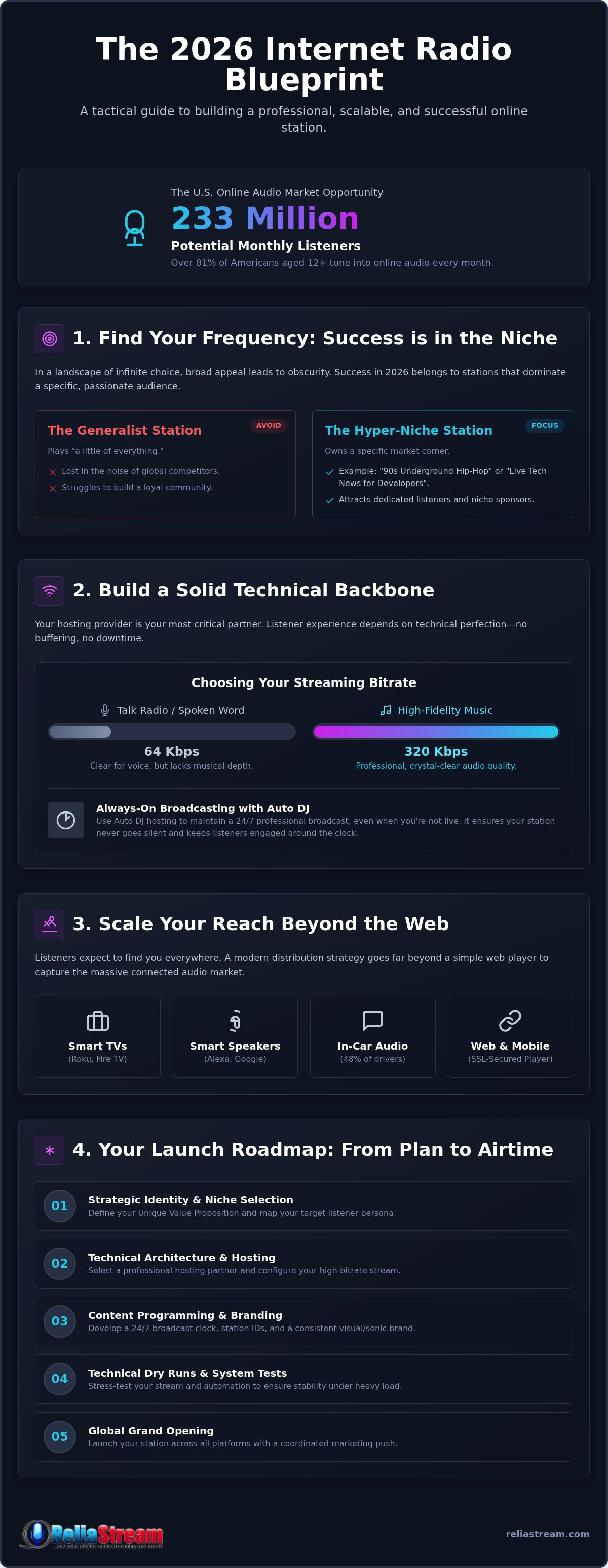
Over 81% of Americans aged 12 and older are now tuning into online audio every single month. That is 233 million potential listeners. Are you ready to reach them? You know the opportunity is massive, but you need a professional internet radio station business plan to turn that potential into reality. Right now, the path to starting feels like a maze of technical jargon. Bitrates. SSL protocols. Hosting versus licensing. It is enough to make any creator hesitate.
This is your tactical blueprint for 2026. We are moving past the "hobbyist" phase and into professional-grade broadcasting. You will learn how to build a stream that scales from day one. We cover the essential infrastructure, from high-quality 320 Kbps hosting to reaching audiences on Roku, Fire TV, and Alexa. No more technical headaches. Just a solid roadmap to a station that sounds elite and stays stable under heavy load. Let's get to work.
Key Takeaways
- Forget generalist stations; success in 2026 requires hyper-niching and a digital-first strategy to cut through the noise of 233 million monthly listeners.
- Learn why your hosting provider is your most critical partner and how to choose between 64 Kbps for talk or professional 320 Kbps for high-fidelity music.
- Discover how to build a sustainable revenue model through direct niche sponsorships and programmatic audio ads reaching smart speaker owners.
- Scale your reach beyond the web by deploying custom streaming apps for Roku, Amazon Fire TV, and Alexa to capture the massive connected audio market.
- Master a step-by-step internet radio station business plan that takes you from technical dry runs to a global grand opening without the system crashes.
The 2026 Radio Landscape: Why Your Plan Needs a Digital-First Edge
FM radio is hitting a wall. The real action? It's happening in the cloud. In 2026, 81% of Americans are tuning into digital audio every month. That is 233 million people. This isn't just a trend. It's a total takeover. If you want to own a piece of this market, your internet radio station business plan cannot be a generic template. It needs to be a tactical growth document that prioritizes technical reliability and global reach.
The old "set it and forget it" approach? It's dead. Listeners expect perfection. They want crystal-clear 320 Kbps audio that never buffers. They want to hear you on their Alexa while they cook. They want to find you on their Roku or Fire TV while they relax. To understand the transition from traditional waves to digital streams, it helps to look at What is Internet Radio? and how it evolved into the powerhouse it is today. You aren't just competing with the local station down the street. You are competing with every stream on the planet.
Executive Summary: The Broadcaster’s Vision
Your vision needs teeth. Don't just say you want to "play music." Define a mission that hits a specific global niche. What is your Unique Value Proposition? Maybe it is exclusive interviews with indie synth-pop artists or a hyper-local news format for expats. Set hard milestones for year one. Focus on listener engagement and session duration rather than just raw hits. A professional plan maps out exactly how your technical backbone supports these goals. If your infrastructure fails, your vision dies. It is that simple.
Market Analysis: Finding Your Frequency
Success starts with scouting. Use directory data and social engagement to see what the big players are missing. Are there genres being ignored? Are there talk formats that feel outdated? Identify your listener persona. Where are they listening? Research shows 48% of drivers now listen to online audio in their cars. Your internet radio station business plan must account for these habits. If your audience is using smart speakers, your distribution strategy must include Alexa and Google TV apps. Don't guess. Build your station around confirmed listener behavior and device trends.
Strategic Identity: Niche Selection and Audience Mapping
You can't be everything to everyone in 2026. The digital dial is infinite. If you try to appeal to a broad audience, you will disappear. Your internet radio station business plan must center on a hyper-niche identity. Success today belongs to the broadcasters who own a specific corner of the market, whether that is 90s underground hip-hop or live tech commentary for remote developers. Hyper-niching isn't just about music choice. It is about survival gear in a crowded audio boom.
Mapping the listener journey is your next priority. It starts with social media discovery. A listener finds a clip on TikTok or Instagram, moves to your web player, and eventually downloads your custom app. Every touchpoint must feel identical. If your branding is inconsistent between your website and your Roku app, you lose trust. This journey is the foundation of a modern internet radio business model that prioritizes long-term retention over one-time clicks. Build a community, not just a stream. Interact with your listeners. Make them part of the broadcast.
Content Strategy and Programming
A professional station never goes silent. You need a 24/7 broadcast clock that balances live energy with automated reliability. This is where Auto DJ hosting becomes your best friend. It maintains your uptime while you sleep, keeping your professional flow intact. Your programming should mix:
- Core Music/Talk Blocks: The meat of your station.
- Station IDs: Frequent reminders of who you are.
- Sweepers and Transitions: Professional bridges between tracks.
- Live Segments: High-impact windows for real-time interaction.
Branding and Visual Identity
Your brand needs to look as good as it sounds. In 2026, people listen in their living rooms. Your logo must be high-resolution and optimized for big screens like Roku and Amazon Fire TV. A professional website with an integrated, SSL-secured web player is non-negotiable. Don't forget your sonic brand. Your intros, outros, and sweepers are the "face" of your station to the ear. They should be punchy, consistent, and high-energy. If you are ready to build this foundation, a professional hosting partner can provide the infrastructure to bring your vision to life.
Technical Architecture: Selecting Your Streaming Backbone
Your hosting provider isn't just a vendor. They are your most critical business partner. If their servers stumble, your station vanishes. A professional internet radio station business plan lives or dies by the technical backbone you choose. You need a partner who understands that "uptime" isn't a suggestion; it is a requirement. Since 2008, professional broadcasters have looked for veterans who can handle the heavy lifting of global distribution while keeping the stream rock solid.
Quality is your calling card. Are you running a talk-heavy news format? A 64 Kbps hosting plan might be your sweet spot for clear, efficient delivery. But if you are spinning high-fidelity music, don't settle for "good enough." You need the audiophile punch of a 320 Kbps hosting plan. This ensures your stream sounds elite on everything from high-end headphones to smart speakers. In 2026, listeners have zero patience for muddy audio or buffering. Scalability is the goal. Your infrastructure must handle listener spikes during peak hours without breaking a sweat.
Security is the silent deal-breaker. Modern browsers like Chrome and Safari are aggressive about security. If your stream isn't served over an SSL radio link, your web player simply won't load for many users. It is a technical barrier that can kill your traffic before it even starts. Professional hosting includes these secured links as standard, ensuring your station is compatible with every modern device and browser on the market.
ShoutCast vs. IceCast: The Protocol Debate
Which engine will drive your station? The choice between ShoutCast vs IceCast depends on your specific goals. ShoutCast remains the industry giant for directory listings. It's the gold standard for being "found." IceCast offers incredible flexibility with mount points and diverse audio formats. Both protocols are stable, but your choice affects how you integrate with third-party directories and mobile players. Pick the one that aligns with where your audience hangs out.
Control Panels: Centova Cast vs. MediaCP
How will you manage the chaos? Managing your library requires a powerful interface. The showdown between Centova Cast vs MediaCP comes down to your workflow. Centova Cast is the reliable veteran known for its rock-solid stability. MediaCP is the modern powerhouse with a sleek, feature-rich interface. Both offer essential Auto DJ capabilities, allowing your station to run 24/7 without a live human at the board. Use real-time analytics to see exactly where your listeners are and how long they stay tuned in. Knowledge is power. Use it to grow.
Revenue and Growth: Building a Sustainable Business Model
Passion starts the station. Profit keeps it on the air. In 2026, relying on a single revenue stream is a recipe for failure. Your internet radio station business plan must prioritize diversification from day one. Direct monetization through ad spots is the classic move. With programmatic audio advertising rates hitting $5 to $15 CPM for standard networks, the volume matters. But don't stop there. Niche brands will pay a premium to reach your specific, hyper-loyal audience. That is where the real money lives.
Think beyond the 30-second spot. Use your station as a platform to sell merchandise or related services. Are you running a jazz station? Sell curated vinyl or high-end audio gear. Listener-supported models are also booming. Platforms like Patreon or direct donation links allow your superfans to fund the dream. Some broadcasters even offer premium, ad-free streams for a monthly sub. It is about giving your audience choices.
The "Living Room Strategy" is your secret weapon. With 100 million Americans now owning a smart speaker, you cannot afford to stay buried in a web browser. People aren't just listening at their desks anymore. They are listening while they cook, clean, and relax. If you aren't on their TV or their kitchen counter, you don't exist. This is how you scale from a hobby to a household name. Capturing that "connected audio" market is the difference between a side project and a professional enterprise.
Distribution and App Strategy
Where are your listeners? They are on their couches. This is why radio streaming app development is the single biggest growth hack for 2026. You need to be a voice command away on Alexa and Google Home. Don't ignore the big directories either. Get listed on TuneIn and iHeartRadio to ensure you are discoverable. But remember; owning your own app means you own the data and the experience. Ready to take over the house? Explore custom app development for Roku and Alexa to put your station center stage.
Marketing and Listener Acquisition
How do they find you? Social media is your funnel. Use short-form video on TikTok or Reels to showcase live moments or track highlights. Drive that traffic straight to your web player. SEO isn't just for blogs. Rank your station website for genre-specific keywords so you show up when someone searches for "best lo-fi radio 2026." Finally, build an email list. It is the only platform you truly own. Turn those casual one-time listeners into loyal daily fans with curated newsletters and exclusive content. Keep them coming back for more.
The Launch Roadmap: Turning Your Plan into Airtime
The plan is on paper. The vision is set. Now, it's time to hit the air. Turning your internet radio station business plan into a living, breathing stream requires a disciplined launch roadmap. Don't rush the "On Air" light. Start with a technical dry run. Test your bitrate. Check your crossfades. Ensure your content buffer is deep enough to handle a full week of automation. This is where you professionalize the operation. One critical step? Implementing SSL radio streaming early. Secure links aren't just a "nice to have" anymore. They are the standard for browser compatibility and listener trust.
Consider a soft launch before the grand opening. Invite a small group of beta listeners to stress test the system. Watch your MediaCP or Centova Cast analytics closely. How does the server react under moderate load? Use this time to refine your programming based on real data. If listeners drop off after three songs, your rotation needs a tweak. If they stay for an hour, you've found your rhythm. Continuous improvement is the secret to staying relevant in a crowded digital dial.
Operations and Legal Compliance
Stay legal from day one. Remember; your hosting provider covers the tech, but you cover the tunes. You must secure music royalty licensing separately. In 2026, SoundExchange commercial rates for non-subscription transmissions are $0.0028 per performance, with a minimum annual fee of $1,100 per station. ASCAP, BMI, and SESAC also have their own specific minimums, often starting around $400 to $600 annually for small businesses. Don't risk a shutdown. Get your paperwork in order. Beyond music licensing, you must also consider digital privacy laws like GDPR; find out more about how to implement cookie banners that don't drive away your listeners. Managing a remote team? Use cloud-based tools to sync your DJs and contributors. Always have a backup plan. If a live stream drops, your Auto DJ must kick in instantly to maintain your uptime.
Growth is the only goal. Once your listener count stabilizes, look at upgrading your technical specs. Moving from a 64 Kbps entry plan to a professional 320 Kbps hosting plan can transform your "audiophile" credibility. Expand your reach with an Alexa Streaming App or a Google TV presence. Voice-activated growth is the future. When a listener says, "Alexa, play my station," you need to be there. Multi-channel networks are the next step. Why run one station when you can run three? Scale hard. Scale fast. Stay loud.
Claim Your Spot on the Digital Dial
The era of traditional broadcasting is over. Digital is the only way forward. You've seen the roadmap. You know that success in 2026 depends on a hyper-niche identity and a rock-solid technical foundation. A professional internet radio station business plan isn't just about the music; it's about distribution. It's about being where your listeners are, whether that's on a smart speaker in the kitchen or a Roku app in the living room.
Don't let technical jargon or complex hosting protocols hold you back. You need a partner that's been in the trenches since 2008. From crystal-clear 320 Kbps audiophile quality to custom Alexa and Roku app support, the right infrastructure makes all the difference. Your voice deserves a platform that won't crash under pressure. Stop planning and start broadcasting. The global audience is waiting to hear what you have to say. Build something that lasts. Take the leap.
Ready to launch? Start your professional radio hosting journey with ReliaStream today!
Frequently Asked Questions
How much does it realistically cost to start an internet radio station in 2026?
Starting an online station is more affordable than ever. Professional hosting plans can start as low as $1.99 per month for entry-level bitrates. However, your total budget should account for music licensing fees and potential custom app development. While basic web-only setups are cheap, scaling your internet radio station business plan to include smart TV apps and high-fidelity 320 Kbps streams will require a larger monthly investment.
Do I need a business license to start an online radio station?
Requirements for a general business license depend on your local government and your station's legal structure. If you are operating as a commercial entity to sell advertising or merchandise, you will likely need to register your business locally. This is separate from music broadcasting rights. Always check with a local legal professional to ensure your station meets all regional tax and operational requirements before you begin broadcasting to a global audience.
How do I handle music royalties and licensing for my station?
ReliaStream provides the technical infrastructure, but you are responsible for securing broadcasting rights. In 2026, most US-based stations must pay royalties to organizations like SoundExchange, ASCAP, BMI, and SESAC. Commercial webcasters currently face a SoundExchange rate of $0.0028 per performance. Failing to secure these licenses can lead to heavy fines or station shutdowns. Always verify the latest rates for your specific region and broadcast format to stay fully compliant.
What is the best bitrate for a professional internet radio stream?
The best bitrate depends entirely on your content and audience. For talk-heavy stations, a 64 Kbps hosting plan provides excellent clarity while saving bandwidth. If you are a music-focused station, 128 Kbps is the industry standard for mobile listening. To truly stand out in 2026, a 320 Kbps hosting plan offers the audiophile quality that high-end listeners expect. High-bitrate streams ensure your station sounds professional on premium home audio systems and smart speakers.
Can I run my radio station entirely through an Auto DJ system?
You absolutely can. Modern control panels like Centova Cast and MediaCP allow you to upload your library and set sophisticated rotation rules. This means your station stays on the air 24/7 without needing a live human at the board. Auto DJ is the backbone of most independent stations, handling everything from track transitions to station IDs. It is an essential tool for maintaining professional uptime while you focus on marketing and growing your brand.
How do I get my internet radio station on Roku and Amazon Fire TV?
Reaching the living room requires custom application development. You can't just upload a stream to these platforms; you need a dedicated Roku Radio App or Amazon Fire TV App. ReliaStream specializes in building these custom gateways for broadcasters. Once your app is live, your station becomes accessible to millions of viewers who prefer listening through their home entertainment systems. It is a massive growth hack for any serious internet radio station business plan.
What is the difference between ShoutCast and IceCast for a new business?
ShoutCast is the veteran protocol, famous for its massive public directory that helps new listeners find your station. It is a great choice if discovery is your top priority. IceCast is highly flexible and supports multiple mount points, allowing you to run different bitrates or formats from a single server. Both are incredibly stable. Your choice depends on whether you want the directory reach of ShoutCast or the technical customization options offered by IceCast.
Why is an SSL stream link important for my radio business?
An SSL Radio Link is mandatory for modern web compatibility. Browsers like Chrome and Safari will block insecure content, meaning your web player won't load if your stream link starts with http instead of https. If you want your station to work on mobile devices and modern websites, you need an SSL-secured link. ReliaStream includes these secured links as standard to ensure your audience never hits a technical wall when trying to listen.


