

What if the segment listeners remember most isn’t a big interview or a pricey production, but a simple idea they can join every week? When a show relies on music and unstructured talk, even a strong playlist can start to feel repetitive. The right creative radio segment ideas give your station a recognizable rhythm and listeners a reason to tune in, respond, and come back.
You don’t need a large team or a complicated script to make a show feel fresh. You need concepts that fit your format, serve your audience, and are easy to repeat without sounding predictable. This guide shares practical ideas for music, talk, and community stations, with ways to adapt each one to your listeners. From themed music picks and quick-fire questions to local spotlights and audience voice notes, you’ll find options to shape into memorable segments that sound like your station.
Key Takeaways
- Make each segment recognizable with a clear hook and a payoff listeners can anticipate.
- Use creative radio segment ideas that invite participation, from listener prompts to local spotlights.
- Compare concepts by audience fit, preparation effort, repeatability, and potential for interaction.
- Build a simple pilot with an opening, a main beat, and a closing, then refine it based on how it works on-air.
- Use scheduled playback and Auto DJ to give recurring features a consistent place between live broadcasts.
Creative Radio Segment Ideas Start with a Clear Listener Hook
A show can have a strong playlist and a confident host yet still feel familiar in the wrong way. If each hour blends into the next, listeners have little to anticipate beyond the next song or topic. The answer isn’t adding more material for its own sake. Give the show a few clear, repeatable features that listeners can recognize and join.
A radio segment is a recurring feature with a distinct premise and a payoff for the audience. It might answer a question, uncover something surprising, or give listeners a chance to contribute. A one-off bit happens once. A recurring segment returns in a recognizable shape, while a full show format is the broader structure that holds the programme together. Understanding the difference helps you develop creative radio segment ideas without making every feature a production.
A strong hook makes a segment easy to remember because listeners know what they’ll get before it begins. Make that promise clear enough to explain in a sentence and flexible enough to deliver fresh content each time.
Radio makes room for many kinds of content, from music and talk to news and entertainment. The history of Radio programming offers useful context, but your next segment can start with a more immediate question: what would make your audience pause and listen?
What makes a radio segment memorable?
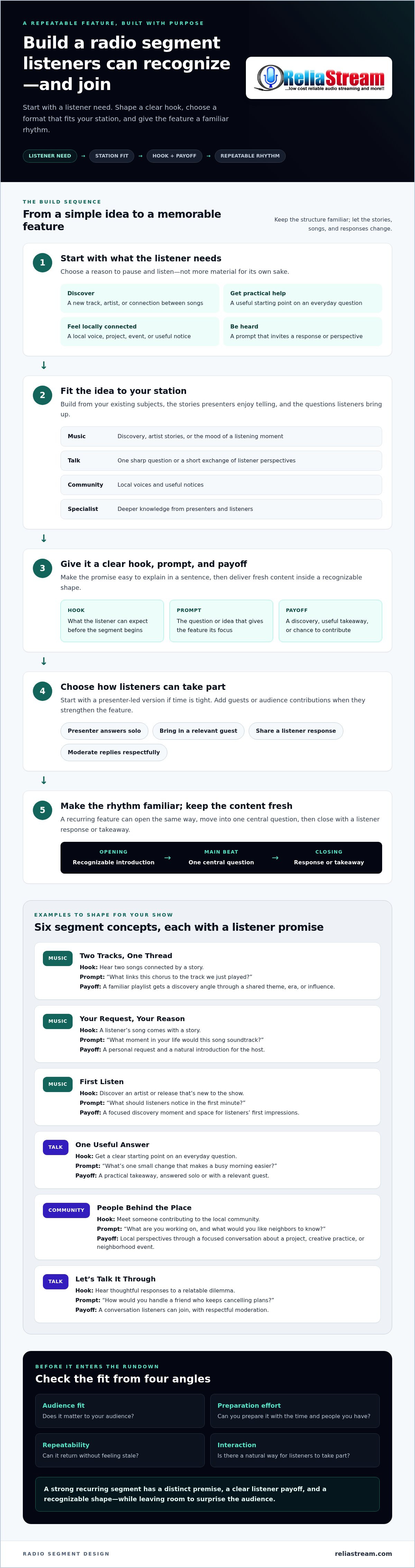
Start with a listener’s curiosity, need, or moment in the day. A breakfast audience might want a quick, useful answer before work; a late-night listener might prefer a thoughtful question that invites reflection. Give the feature a concise name that signals its premise, such as “First Listen” for a new track or “Local Lowdown” for a community update. Treat these as starting points, not scripts.
Keep the structure familiar while changing what fills it. A weekly feature could open with the same short introduction, move into one central question, then close with a listener response or takeaway. The audience learns the rhythm, while the host still has room to surprise them.
Match creative segment ideas to your station’s identity
A music station can build around discovery, artist stories, or the mood of a particular listening moment. A talk station might focus on one sharp question or a short exchange of listener perspectives. A community station can make space for local voices and useful notices, while a specialist station can draw on presenters’ and listeners’ deeper knowledge.
Use your station’s existing subjects, the stories presenters enjoy telling, and the questions listeners bring up as starting points. Then choose a delivery style that feels right for your show. A borrowed trend or forced gimmick may attract attention briefly; a feature rooted in your station’s personality gives listeners a reason to return.
Creative Radio Segment Ideas for Music, Talk, and Community Shows
A feature doesn’t need a complicated setup to work. Start with a clear listener payoff, then choose a format that matches your show’s personality. The concepts below include quick, presenter-led options and features that can grow through audience input or guest contributions.
Music radio segment ideas listeners can anticipate
- Two Tracks, One Thread. Hook: Hear two songs connected by a story. Prompt: “What links this chorus to the track we just played?” Value: Gives a familiar playlist a discovery angle. Choose the tracks and find one concise connection, such as a shared theme, era, or influence.
- Your Request, Your Reason. Hook: A listener’s song comes with a story. Prompt: “What moment in your life would this song soundtrack?” Value: Makes a request feel personal and gives the host a natural introduction. Invite short responses, then select one to share on air.
- First Listen. Hook: Discover an artist or release that’s new to the show. Prompt: “What should listeners notice in the first minute?” Value: Adds a focused discovery moment without assuming what the audience already knows. Introduce one selection and invite listeners to share their first impression.
Talk and community radio segment ideas
- One Useful Answer. Hook: Get a clear starting point on an everyday question. Prompt: “What’s one small change that makes a busy morning easier?” Value: Gives talk programming a practical takeaway. The host can answer a simple question solo or bring in a relevant guest for more depth.
- People Behind the Place. Hook: Meet someone contributing to the local community. Prompt: “What are you working on, and what would you like neighbors to know?” Value: Introduces local perspectives through a focused conversation. Keep the guest theme specific, such as a community project, creative practice, or neighborhood event.
- Let’s Talk It Through. Hook: Hear thoughtful responses to a relatable dilemma. Prompt: “How would you handle a friend who keeps cancelling plans?” Value: Opens a conversation listeners can join. Set a respectful tone, moderate replies, and keep disagreement from becoming a personal attack.
Some ideas serve discovery, others offer practical help, local connection, or a chance to be heard. Choose the listener need first, then build the segment around it. Start with a solo version if time is tight; add guests or audience contributions when they strengthen the feature. A planned segment also needs a dependable place in the schedule. Internet radio hosting can support a consistent broadcast routine.
How to Choose a Radio Segment Idea That Fits Your Show
A clever concept isn’t automatically the right fit. Before adding one to your rundown, ask four questions: Does it matter to your audience? Can you prepare it with the time and people you have? Can it return without feeling stale? Is there a natural way for listeners to take part? These checks help narrow creative radio segment ideas to features your station can sustain.
Use this comparison as a starting point. Production effort reflects a typical setup, but a segment can become more demanding if you add guests, research, or audience submissions.
| Segment concept | Best-fit format | Listener hook | Production effort |
|---|---|---|---|
| Themed track pairing | Music-led | Two selections connected by a story or idea | Low |
| Expert answer | Talk | A focused response to one useful question | Medium |
| Neighborhood noticeboard | Community | Local updates listeners can use | Low to medium |
| Guest conversation | Talk or community | A local person shares a relevant perspective | High |
Which segment ideas suit different station formats?
Music-led stations can build around discovery, themed selections, or concise artist context while keeping the music central. Talk formats can use expert answers, listener questions, or debate prompts with a clear point to discuss. Community stations can focus on local voices, useful notices, and neighborhood stories. These are adaptable starting points, not format rules. A music presenter can host a local feature; a community show can spotlight new sounds if that serves its audience.
Choose an idea that sounds like a natural extension of your station, not a bolt-on. A specialist show might draw on its subject knowledge, while a broad-format station could keep the premise accessible and let each week’s topic bring something new.
How much preparation does each segment need?
Host-led features, such as a short themed selection or a response to one question, may need only a prompt and a few notes. Research-based explainers require checking details. Guest interviews add coordination, preparation questions, and a plan for keeping the conversation focused. Listener contributions can bring energy, but collecting and selecting responses also takes time.
More preparation can be worthwhile if a feature delivers a distinctive payoff, supports an editorial goal, or brings a valuable voice to the show. Be realistic about the workload. A simple template can make recurring preparation easier: premise, opening line, main question or beat, and closing thought. Reuse the structure, not the content.
Live callers, elaborate production, and celebrity guests aren’t requirements for a strong segment. A sharp question and a prepared presenter can carry a feature. Keep creative planning separate from music licensing questions. Choose an idea you can deliver consistently, then adjust its scope to match your team and schedule.
Turn a Creative Radio Segment Idea into a Repeatable Feature
A promising concept becomes useful programming when you can produce it consistently. Keep the first version small, learn from putting it on air, then decide whether it deserves a regular place in the show. This cycle helps turn creative radio segment ideas into features that fit both the audience and the team behind the mic.
Work through four steps: define the promise, outline the format, produce a pilot, then refine. The promise keeps the segment focused. The outline gives the presenter a reliable path through it. A pilot tests how the idea sounds in practice before you make it a fixture.
Build a simple segment template
Write one sentence describing what listeners can expect. For example: “Each feature pairs a familiar song with a surprising connection.” Then map out the essential beats. You’re creating a guide, not a script, so the presenter can keep the delivery natural.
- Opening cue: Use a consistent phrase or sound that signals the feature has begun.
- Central activity: Set one clear task, question, or story for the segment to deliver.
- Natural sign-off: End with a takeaway, a listener prompt, or a transition back to the show.
- Backup prompts: Prepare a few related questions or angles in case the first one runs out of steam.
A practical-question feature, for instance, might open by stating the day’s question, offer a host’s answer or guest perspective, then close with one action listeners can consider. The same structure can support a fresh topic each time. Keep notes brief enough to scan during a live broadcast, and flag anything that needs research or coordination before airtime.
Test the idea and improve it over time
Run a short pilot before placing the feature into the regular schedule. Treat it as a test, not a verdict. Notice where the presenter hesitates, whether the central idea comes through clearly, and whether the ending feels complete. A recording or rundown review can help the team spot awkward transitions and tighten the sequence.
After the pilot, look at qualitative signals. Did listeners send messages, respond to the prompt, or mention the feature afterward? Did the presenter have enough material, and was preparation manageable alongside the rest of the show? These observations help you judge whether the segment connects with listeners and is sustainable without relying on invented performance targets.
If the idea feels repetitive, rotate the question, guest perspective, or source of contributions while keeping the core promise intact. If preparation becomes a burden, simplify the format or reduce the research it requires. A small pilot shows whether a feature can earn its place in the schedule without becoming a burden to make.
Once recurring features have a place in the rundown, support their consistency with a dependable broadcast setup. Explore internet radio hosting as you plan how your station will deliver its programming.
Keep Creative Radio Segments Consistent with the Right Streaming Setup
A recurring feature works best when listeners can count on finding it in the schedule. That doesn’t mean every segment needs to be live. A dependable streaming setup and a clear programming plan can help your station keep its rhythm between live broadcasts, giving a planned feature a reliable place in the lineup.
Practical station operations matter, too. If you’re reviewing how your setup supports the schedule you want to run, this budget internet radio hosting guide covers considerations for getting an internet station started and running.
Use automation to support a consistent schedule
Auto DJ can support scheduled or automated playback between live shows. For example, a station could arrange recorded material or programming to play in a planned sequence while the presenter is off air. That can help maintain continuity and protect the time set aside for recurring features.
ReliaStream hosting includes access to Centova Cast or MediaCP control panels. These tools support station operations, while the editorial choices remain yours: what the segment is about, how it sounds, and what listeners get from it. Automation handles playback tasks. It doesn’t replace the presenter’s judgment or the creativity behind the feature.
Think of the schedule as a framework, not a substitute for good programming. Mark recurring features clearly in your rundown, leave room for live content where it belongs, and plan what should play around those moments. A dependable streaming routine can make it easier to deliver creative radio segment ideas consistently, whether your station is live or using scheduled playback.
Help listeners find your station on their devices
Listeners may tune in through different devices and platforms, so consider where your station’s stream can be accessed. Custom apps for Roku, Google TV, and Amazon Fire TV can offer additional listening destinations. Alexa streaming skills provide another way to access a station through supported devices. These options can make the stream available in more listening contexts, but an app alone doesn’t guarantee audience growth or specific listening results.
Choose access options that make sense for your station and its listeners. Keep the core programming promise clear wherever the stream is heard, and give recurring features a predictable place in the schedule. Consistency comes from both the content and the operation behind it.
To explore how stations can make their streams accessible on supported platforms, read about radio streaming app development.
Give Your Next Segment a Place to Grow
Your next show doesn’t need a complete overhaul. Pick one idea that feels true to your station, shape it around a listener promise, and give it room to develop. A feature can start small, then evolve as you learn what your audience responds to and what your team enjoys making. That’s how creative radio segment ideas become part of a station’s personality, not just another item in the rundown.
When you’re ready to make a new feature part of your regular programming, consider how your streaming setup can support the schedule you’re building. ReliaStream has supported internet broadcasters since 2008, with hosting options for stations developing their own sound and programming routine.
Explore ReliaStream internet radio hosting and find a practical foundation for your station’s next chapter. Start with one strong idea, keep experimenting, and let your show grow into something listeners look forward to.
Frequently Asked Questions
What are some creative radio segment ideas for a music station?
A music station can turn listening into a small game, such as asking audiences to guess which of two tracks came first, then revealing the answer with brief context. Another option is a “sound check” feature that spotlights one instrument or production detail in a selected song. Choose a prompt that suits your station’s genre, and keep the explanation accessible so devoted fans and casual listeners can follow along.
How long should a radio segment be?
There’s no universal ideal length. Let the segment’s purpose and the surrounding show determine its runtime. For a quick feature between songs, write down the essential point and remove any setup that delays it. For an interview, decide what listeners should learn and prepare questions that keep the conversation moving toward that outcome. Review a recording afterward: if a passage adds no useful context or interest, tighten it.
Can a small radio station create engaging segments without guests?
Yes. A solo presenter can make a feature engaging by bringing a clear point of view, useful context, or a well-chosen question to the mic. For instance, a host could explain why a local event matters to listeners or compare two songs through a shared lyrical theme. Keep a short note sheet nearby rather than scripting every line. That leaves room for a natural delivery while keeping the feature focused.
How do I make a radio segment stand out?
Give the feature a perspective listeners can recognize as yours, not just a familiar topic with a new label. For example, instead of simply announcing a new release, explain what detail caught your attention and invite listeners to listen for it. Among creative radio segment ideas, a distinctive angle is often what makes a premise feel fresh. Check that the idea reflects your station’s voice before adding extra production.
What makes a radio segment interactive?
An interactive segment gives listeners a clear, low-friction way to respond and makes their participation relevant to the feature. Ask one focused question rather than requesting open-ended thoughts on a broad subject. Explain what kind of response you’re looking for, such as a brief recommendation or a personal perspective. Then shape the segment so it remains worthwhile for people who simply listen and don’t send anything in.
How often should a recurring radio segment run?
Set a schedule that matches how often the idea can deliver something fresh and how much preparation your team can manage. A feature tied to changing local events may need a different cadence from one built around a broad topic. Before choosing, map out several possible installments; if ideas are hard to find, space the segment farther apart. Revisit the schedule as the show evolves rather than keeping a slot out of habit.


