

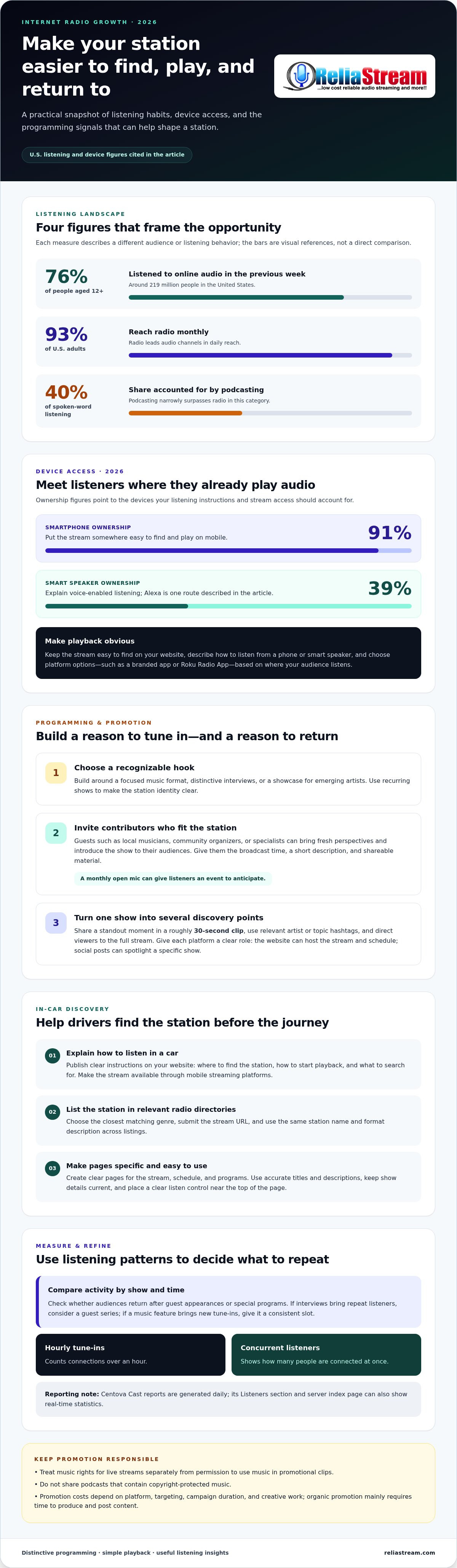
In the United States, 76% of people aged 12 and over listened to online audio in the previous week. To get more listeners for my internet radio in 2026, focus on distinctive shows, regular promotion, and making your stream easy to find and play across phones, smart speakers, and cars. Then use listening patterns to shape content and reach the audiences most likely to tune in.
Promoting your station takes more than posting a stream link and hoping people find it. You need a clear reason to listen, plus simple ways for new fans to discover your shows, join in, and come back.
This guide shares practical ways to attract listeners, reach people in cars, and tailor your programming and platforms to different audiences. From guest features and social clips to station directories and listening insights, these steps can help build momentum while preserving what makes your station distinctive.
Key Takeaways
- Give listeners a clear reason to tune in with distinctive programming, guest appearances, and ways to participate.
- Make your station easy to play on mobile devices and smart speakers, then promote the listening options your audience already uses.
- Help drivers discover your station by adding it to relevant radio directories and making your stream accessible for in-car listening.
- Use listening patterns and audience interests to shape your shows and choose the platforms that best fit different listener groups.
1. How do you attract radio listeners?
Give your station a clear hook: a focused music format, distinctive interviews, or a showcase for emerging artists. A practical plan for how to get more listeners for my internet radio 2026 begins with a reason to tune in and a reason to return. Choose a recognizable theme, then build recurring shows around it.
Invite guests whose work fits your station’s identity. A local musician, community organizer, or specialist can bring fresh perspectives and introduce your show to their own audiences. Make the appearance easy to promote: send guests the broadcast time, a short description, and a clip or image to share. A monthly open mic, held virtually or in person, can bring new voices to the station and give listeners an event to anticipate.
Radio and podcasts reach audiences in different ways. In the United States, 76% of people aged 12 and over listened to online audio in the previous week, around 219 million people. Radio reaches 93% of U.S. adults monthly and leads audio channels in daily reach. Podcasting accounts for 40% of spoken-word listening share, narrowly surpassing radio in that category. Use these patterns to consider which shows suit live broadcasts and which segments could work on demand.
Use your radio server’s statistics to track growth. Compare listening activity by show and time, and see whether audiences return after guest appearances or special programs. Distinguish hourly tune-ins from concurrent listeners: the first counts connections over an hour, while the second shows how many people are connected at once. Centova Cast reports are generated daily; its Listeners section and server index page can also show real-time statistics.
Use those insights to refine your programming, not chase every trend. If interviews attract repeat listeners, develop a guest series; if a music feature brings new tune-ins, give it a consistent slot. For broadcasters asking how to get more listeners for my internet radio 2026, the next step is to test one programming change and measure its audience response.
2. How can I promote my radio station?
Make listening simple on the devices your audience already uses. In the United States, 91% of people owned a smartphone in 2026, while smart speaker ownership reached 39%. Put a clear play button on your station website, keep the stream easy to find, and explain how to listen from a phone or smart speaker. A branded mobile app can keep your station visible and give regular listeners a direct route back to your format. For voice-enabled listening, the Alexa Streaming App offers one route to make a station stream accessible through Alexa.
Give each platform a specific role. Your website can host the stream and schedule, while social posts can direct people to a featured show or app. Make the next step simple, such as opening your station app or asking a smart speaker to play your station. A Roku Radio App can also make the station available on Roku devices. Choose platforms based on where your audience listens, rather than adding them without a clear purpose.
US music licensing rules matter when your stream or promotional content includes copyrighted music. Treat rights for music in live streams and promotional clips separately from permission to post on a social platform. Do not share podcasts that contain copyright-protected music.
Promotion costs in 2026 depend on the platform, audience targeting, campaign duration, and creative work; organic promotion mainly requires time to produce and post content. Set a budget around the audience and campaign you want to reach, then track whether people visit your stream or app.
Short-form video, podcasts, and social media can turn one show into several discovery points. Share a standout mix moment in a roughly 30-second clip, post it with relevant artist or topic hashtags, and direct viewers to the full stream. Avoid misleading claims, repetitive spam, or posting music in podcasts when it’s copyright-protected. For a direct listening route, the Alexa streaming app can connect station promotion with smart-speaker access.
3. Making the station available for in-car listening
Drivers can become regular listeners when your stream is easy to find and play. Make the station available through mobile streaming platforms, then publish clear instructions for listening in a car. Explain where to find the station, how to start playback, and what to search for. Keep the instructions on your website so drivers or passengers can set things up before a journey.
Radio directories can introduce your station to people browsing by genre. Find directories that accept internet radio listings, choose the closest matching category, and submit your stream URL. Use the same station name, format description, and genre across listings. Consistent details help people recognize your station wherever they find it.
Improve discoverability on Google, social media, and radio directories by using your station name, genre, and show topics consistently. Create clear website pages for the stream, schedule, and programs, then share short posts that direct people to specific shows. In directories, select the accurate genre and provide the stream URL so listeners can tune in.
For Google search, write useful page titles and descriptions that accurately describe each page. A page about a local jazz show, for example, should explain its music and schedule instead of repeating broad keywords. Add a clear listen button near the top of the page, make the stream easy to use on mobile, and update show details when schedules or presenters change.
Merchandise can extend your station’s identity beyond streaming, but choose items people will use. Consider durable products made from recycled or responsibly sourced materials, such as a reusable tote featuring your station name. Promote merchandise on a show page or in a social post, and connect the design to your format. A clear purpose makes it more meaningful than a logo on an object.
Review directory listings and search pages regularly. Test each stream link, check that the station name and genre match, and replace outdated schedules. These small maintenance steps keep discovery paths working as your programming evolves.
4. Demographic and platform differences in radio listening
A single schedule won’t fit every listener. In the United States, 45% of people aged 12 and over listened to podcasts in the previous week, while 46% of people aged 13 and older listen to spoken-word audio daily. These habits point to different reasons for tuning in. Build distinct music, interview, and talk formats, then record which shows attract repeat listening.
Genre preferences also vary. In Q1 2026, News/Talk held a 10.9% share of total U.S. radio listening among adults aged 18 and older. Adult Contemporary had a 7.1% share, Country 5.8%, and Pop Contemporary Hit Radio 4.3%. These figures describe broad listening patterns, not a formula for every station. Use them to test relevant programming ideas, then let your own audience response guide decisions.
Age groups can show different genre interests, too. Among U.S. listeners aged 18-34 in Q1 2026, Hot Adult Contemporary had a 5.6% share, Classic Hits 5.4%, and Alternative 4.2%. If your station targets younger listeners, test a focused show or recurring feature before changing the full schedule. Compare its listening pattern with other programs.
Platform habits matter alongside genre. Streaming music services accounted for 16% of U.S. daily ad-supported audio listening time in Q1 2026. Radio and podcasts together accounted for 82% of that listening time. Give each platform a clear role: use live radio for scheduled shows, and make spoken-word segments easy to discover and share where appropriate.
Track performance by show, time, format, and listening platform. Compare similar time slots and note which episodes bring listeners back. If one audience responds to interviews while another prefers music, adjust promotion and programming for each group instead of treating every listener alike. Segment based on observed behavior, test focused changes, and keep what earns engagement.
ReliaStream: 32 Kbps Hosting Plan
ReliaStream gives internet broadcasters hosting options for delivering their stream to listeners and directories. Choose among the 32 Kbps Hosting Plan, 64 Kbps Hosting Plan, 128 Kbps Hosting Plan, and 320 Kbps Hosting Plan to match your station’s streaming needs. If you’re expanding promotion across platforms, a consistent stream link helps connect your website, directory listings, and listening apps. ReliaStream also offers an SSL Radio Link for secure streaming. Hosting supports the technical side of audience growth; your programming, promotion, and listener experience remain central to building a loyal audience. Contact ReliaStream to discuss hosting for your station.
Turn your next broadcast into a growth test
Choose one audience you want to reach next, then give them a clear reason to return. Try a focused show, a fresh guest format, or a listening option designed for a platform you haven’t prioritized. Track what brings people back, and use those signals to guide your next programming decision. That’s a practical way to approach how to get more listeners for your internet radio in 2026: keep improving the experience, not just the promotion.
Reliable streaming provides the foundation for that work. ReliaStream offers the 32 Kbps Hosting Plan, 64 Kbps Hosting Plan, and 128 Kbps Hosting Plan, giving broadcasters hosting options for their stations. Match the setup to your stream, then focus your energy on programming and audience connection.
Ready to take the next step with your station? Contact ReliaStream to discuss your station and keep building your audience with purpose.
Frequently Asked Questions
How can I promote my radio station?
Give each promotion one clear destination and one action. For example, send a social post about a themed show to a page with the episode details, broadcast time, and a prominent play button. Use a distinct tracking link for each campaign, then compare visits with listening activity. That helps show which message attracts actual listeners, not just reactions.
How do you attract radio listeners?
Make your station’s identity easy to recognize, and explain why someone should choose it. A station focused on independent music, for example, can spotlight an emerging artist each week and share a short introduction to their sound. Invite replies through song requests or topic prompts, then use audience responses to shape future programming and encourage participation.
What are the most effective ways to promote an internet radio station in 2026?
Use a repeatable campaign instead of isolated announcements. Build a short sequence around an upcoming show: announce its theme, share a preview, remind followers when it begins, then post a follow-up pointing to the next broadcast. Keep your station name and visual identity consistent throughout. Review which campaign brings people back and refine the next sequence accordingly.
Which internet radio directories and streaming platforms are best for gaining listeners?
Choose directories that categorize stations by their actual format and make the stream easy to open. Before submitting, prepare a concise station description, matching genre labels, and a working stream link. Prioritize platforms your intended audience already uses and where your station can be presented clearly. A focused presence is easier to maintain than scattered, outdated listings.
How do I build a loyal audience with a consistent schedule, niche programming, and listener interaction?
Give listeners a dependable appointment, such as a weekly specialist show at the same time, and keep its topic distinct. Invite a specific response during each broadcast, such as questions for an upcoming discussion. Address selected contributions on air and explain how to participate next time. This visible feedback loop gives regular listeners a reason to return.
What are the best free and paid advertising options for promoting an internet radio station in the US?
Free promotion can include regular Facebook posts, artist collaborations, and mentions in community newsletters. For paid reach, try targeted campaigns on social platforms or Google, choosing interests and audience characteristics that fit your station’s format. Start with one show or audience segment, then compare visits and listening activity with campaign spending before expanding.


