

You can launch a professional global radio station for less than the price of a morning latte. Seriously. The entry barrier to professional broadcasting has officially collapsed. If you’ve been stalling because you’re terrified of hidden fees or massive hardware bills, it’s time to wake up. Calculating the cost to start a streaming radio station shouldn't feel like solving a high-level calculus equation. You don't need a $10,000 studio to reach millions of ears. Why let technical confusion hold your voice back?
We know the frustration. You’re likely overwhelmed by the noise surrounding music licensing rates and hardware requirements. This guide cuts through the fluff to deliver the exact financial breakdown of starting an internet radio station in 2026. We’ll explore tiered budgets, explain the difference between essential hosting and optional gear, and show you how to scale your reach to smart speakers and TV apps without losing your shirt. It’s time to stop dreaming and start broadcasting.
Key Takeaways
- Start for less than $2. Professional-grade hosting is the foundation of every successful station.
- Know the real cost to start a streaming radio station. Learn to separate your hosting fees from music licensing royalties.
- Ditch the "free hosting" trap. Spot hidden bandwidth overages before they wreck your budget.
- Pick your path. Whether you're a hobbyist or a pro, we break down the gear and bitrate requirements for every level.
- Think bigger. Scale your station with custom apps for Roku, Fire TV, and Alexa to dominate the global market.
What is the Real Cost to Start a Streaming Radio Station?
The financial barrier to professional broadcasting has officially vanished. You can launch a station today for less than five dollars a month. That is the price of a single fancy coffee. If you look at the history of what is internet radio, you will see a massive shift from complex, expensive setups to streamlined digital solutions. The game has changed. You don't need a massive loan or a venture capital backer to get your voice heard across the globe.
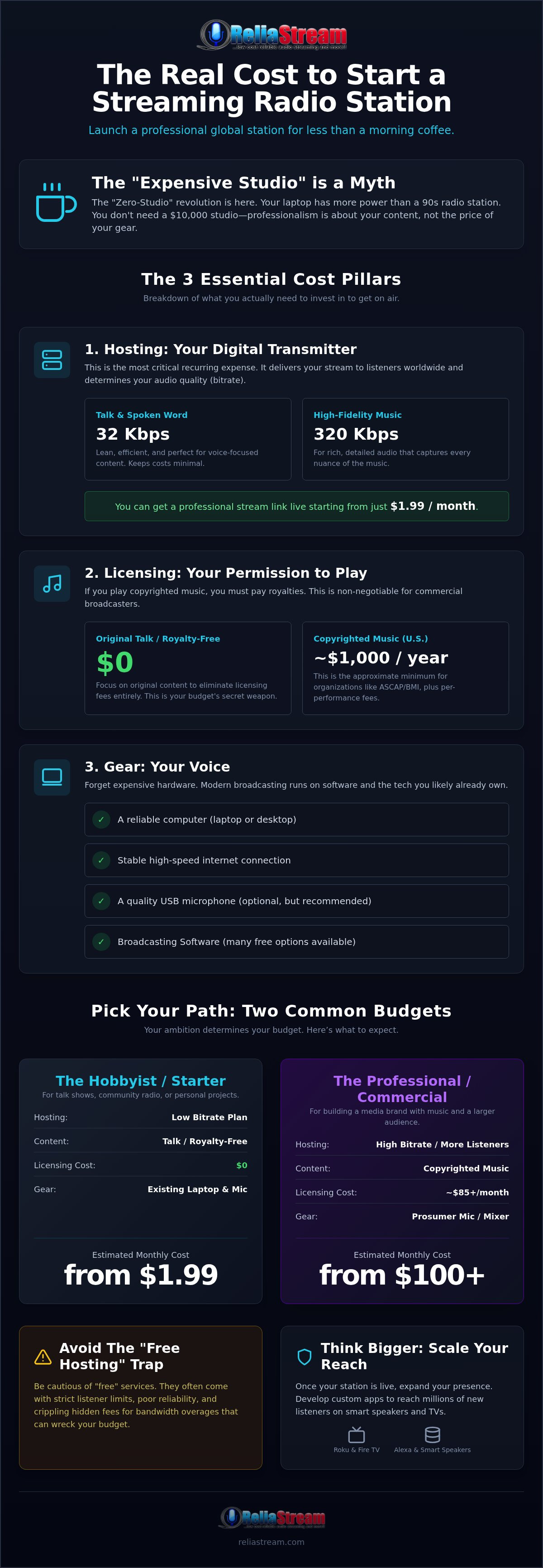
Calculating the cost to start a streaming radio station depends entirely on your ambition. Are you broadcasting a hobbyist show to a few dozen friends, or are you building a professional media empire? Your budget scales with your needs. The main variables include your desired audio quality, the number of simultaneous listener slots you want to fill, and the automation tools you use to keep the station running while you sleep. A 32 Kbps talk station costs significantly less to host than a 320 Kbps high-fidelity music stream. It is all about choosing the right foundation for your specific vision.
Breaking Down the Minimum Entry Requirements
Your first essential investment isn't a mahogany desk or a neon "On Air" sign. It is a professional stream link. This is the digital backbone of your operation. Streaming Hosting is the digital transmitter of your station. Without it, your audio has nowhere to go. Beyond hosting, your primary monthly overhead is high-speed internet. It serves as your only physical "transmitter" line. You need a stable upload speed to ensure your stream doesn't buffer or drop out when the listener count spikes. Reliability is the currency of the digital age.
The Myth of the Expensive Studio
Forget the five thousand dollar consoles. Forget the soundproof bunkers. The laptop sitting on your kitchen table right now likely has more processing power than a 1990s FM radio station. The "Zero-Studio" revolution is here. Virtual mixers and Auto DJ tools have replaced racks of heavy, heat-generating hardware. You can now schedule tracks, mix levels, and broadcast live from a single screen. Why spend thousands on a physical console when software does it better? Modern broadcasters prioritize accessibility and results over formal polish. You can start with the tech you already own and upgrade as your audience grows. Professionalism is about the quality of your content, not the price tag on your microphone.
The Essential Cost Pillars: Hosting, Licensing, and Gear
Hosting is your transmitter. Licensing is your permission slip. Gear is your voice. These pillars define the total cost to start a streaming radio station. You cannot ignore them, but you certainly shouldn't overspend on them either. Successful broadcasters know where to invest for quality and where to cut the fat. It’s about building a lean, mean broadcasting machine that sounds like a million bucks without actually costing it.
Hosting Plans and Bitrate Selection
Your hosting plan is the single most important recurring expense. It determines how many people can listen at once and how good those listeners think you sound. Bitrate is the key variable here. A 32 Kbps stream is lean and perfect for talk radio or sports play-by-play. If you're spinning high-fidelity tracks, you’ll want a 320 Kbps plan to capture every nuance. High-quality audio requires more bandwidth, which naturally shifts your monthly overhead.
Don't get bogged down in technical debt. Choosing between ShoutCast vs IceCast depends on your specific budget and the player compatibility you need. Most beginners find that radio hosting starting at $1.99 provides more than enough power to get a professional stream link live. You can always scale up as your audience grows. Reliability beats raw power every single time.
The Licensing Landscape in 2026
If you play copyrighted music, you have to pay the artists. There is no way around this. In the U.S., performing rights organizations like ASCAP, BMI, and SESAC collect these fees. For 2026, the verified minimum for commercial webcasters is approximately $1,000 annually per channel. This covers your basic royalty obligations, but you also need to track performances. Most services charge around $0.0025 per non-subscription performance.
Talk radio is your budget's secret weapon. If you focus on original talk content, news, or royalty-free music, your licensing costs can drop to zero. Don't let music licensing complexities scare you away from the mic. You can use third-party aggregators to handle the paperwork, or focus on talk-based formats to keep your overhead minimal while you build your brand.
Hardware: Entry-Level vs. Pro Broadcaster
You can start for zero dollars. Use your laptop's internal soundcard and a basic smartphone headset. It won't sound like the BBC, but it gets you on the air. For those ready to sound professional, a $200 "Pro-Sumer" kit is the sweet spot. A Samson Q2U or an Audio-Technica ATR2100x-USB provides broadcast-quality audio for under $100. Add a pop filter and a boom arm, and you're ready to compete.
Only invest in a full internet radio station setup with physical mixers and XLR microphones when your listener base justifies the spend. Calculating the cost to start a streaming radio station is easier when you treat gear as an earned upgrade rather than a day-one requirement. Ready to lock in your foundation? Grab a high-performance hosting plan and get your station on the air today.
Three Budget Paths: Which One Fits Your Vision?
Stop waiting for a massive windfall to launch your station. The most successful broadcasters didn't start with a million-dollar studio; they started with a clear vision and a budget that matched their current reality. The cost to start a streaming radio station is a sliding scale. You choose your entry point. You control the overhead. Whether you are broadcasting from a bedroom or a dedicated office, there is a financial path that works for you right now. Scalability is your greatest asset. Start small, nail your format, and reinvest as your listener count climbs.
The $10/Month Starter Budget
This is the ultimate testing ground for hobbyists and niche creators. If you are launching a community news program or a podcast-style talk station, you don't need massive bandwidth. Focus on low bitrate radio hosting to keep your monthly bills under ten dollars. At this level, you are using the hardware you already own. Your current laptop is your console. Free automation software handles your playlist rotations. It is lean. It is efficient. Most importantly, it gets you on the air without financial stress. It’s perfect for passion projects that need to prove their value before scaling up.
The $50/Month Professional Growth Budget
Ready to sound like the big players? This is the semi-pro path. Here, you prioritize audio fidelity and listener experience. You’ll likely step up to 128 Kbps or 320 Kbps bitrates to ensure your music sounds crystal clear on high-end speakers. Management becomes a breeze when you choose between centova cast vs mediacp to handle your media library and listener statistics. You are also investing in SSL security for your stream links to ensure compatibility with modern browsers. This budget allows for smart automation, meaning your station stays active 24/7 even when you aren't at the mic. It’s a professional foundation built for growth.
The Enterprise Broadcaster: Investing in Reach
At the enterprise level, you aren't just a station; you are a brand. You need high-capacity listener slots to handle viral traffic and peak hour spikes. This is where you move beyond a simple web player and invest in radio streaming app development. You want your station on Roku, Amazon Fire TV, and Alexa. You want to be in the listener's living room and car. This path requires a larger investment in reach and dedicated support, but it offers the 99.9% uptime guarantees that professional advertisers demand. You are building a global media presence. Why settle for a local audience when the technology exists to reach the entire world?
Hidden Costs and How to Avoid the 'Money Pit'
Don't let a low sticker price fool you. The total cost to start a streaming radio station often hides in the fine print of 'unlimited' plans and 'free' services. You think you're saving cash? Think again. Bandwidth overages can turn a budget project into a financial nightmare overnight. Many providers claim 'unlimited' traffic but throttle your bitrate once you gain actual traction. It's a bait-and-switch. Then there’s the 'death by a thousand cuts' from software subscriptions. Every little 'pro' feature or specialized encoder adds up. If you aren't careful, your station becomes a money pit before you even hit your first hundred listeners.
The True Cost of 'Free' Streaming
Free hosting is the ultimate trap. Why? Because you pay with your audience. Forced ads from third-party providers drive listeners away faster than dead air. You lose total control over your brand. Even worse is the lack of ssl radio streaming. Modern browsers like Chrome and mobile operating systems now block non-secure stream links by default. If your stream isn't encrypted, it simply won't play on most smartphones. Owning your stream link is a non-negotiable asset. Without it, you are building your house on someone else's rented land. You need a dedicated, secure link to ensure 100% reach across all devices.
Automation vs. Live Hosting Costs
Running a 24/7 station from your home computer sounds cheap. It isn't. Factor in the rising electricity bills and the inevitable hardware wear-and-tear of a machine running at full tilt. It's a recipe for a fried motherboard and a dead station. Cloud-based Auto DJ services are the smarter, more efficient play. By offloading the processing power to the server, you save on local energy costs and extend the life of your physical gear. Your station stays live while your laptop stays cool and quiet.
Software subscriptions are another silent killer. You start with a free trial of a virtual mixer. Then you need a specialized plugin for sound processing. These fees stack up quickly. Manage these costs early by choosing a hosting provider that bundles essential tools. It’s about being cost-efficient, not just cheap. Don't let hidden fees sink your dream before it sails. Grab a reliable radio hosting plan that keeps your costs predictable and your stream secure.
Launching Your Station: The Smart Financial Roadmap
Stop overthinking the technicalities. Start broadcasting. The true cost to start a streaming radio station isn't a barrier; it's a series of strategic choices. You don't need a massive launch budget to build a loyal audience. You need a plan. By following a smart financial roadmap, you can avoid the 'money pit' and focus on what actually matters: your content. Low risk. High reward. This is how you build a digital empire from scratch.
Step one is defining your format. Talk radio is your budget's best friend. Since you aren't paying the $1,000 annual minimum for music licensing, your overhead stays incredibly low. If music is your soul, factor in those royalties early. Step two is securing professional hosting. Start with a lean plan and scale as your listener count grows. Step three is leveraging Auto DJ. It keeps your station on-air 24/7 without burning out your home computer or your electricity budget. Finally, once you have traction, expand your reach. Got traction? Now expand. Reach listeners on their TV or smart speaker. Calculating the cost to start a streaming radio station shouldn't be a guessing game. It's about smart, incremental growth.
The ReliaStream Advantage for New Broadcasters
Our $1.99 plans are the perfect 'sandbox' for new stations. You get a professional stream link without the professional price tag. Master the controls before you go big. As you transition from hobbyist to pro, we grow with you. We specialize in building custom Roku and Alexa skills that put your station in the living room. No-nonsense support comes standard. We help you avoid the expensive technical mistakes that sink most independent broadcasters. We are your backbone. You bring the voice; we provide the power.
Your First 30 Days: A Spending Checklist
Don't buy everything at once. Focus on the essentials to get live, then reinvest your growth. Keep it lean. Keep it professional.
- Priority 1: Hosting and Stream Link (Essential). This is your digital transmitter. Secure it first.
- Priority 2: Basic Mic and Headphones (Essential). Use a Samson Q2U or similar USB mic for broadcast quality on a budget.
- Priority 3: Custom Branding and Apps (Growth Phase). Once you have a steady listener base, invest in Roku and Fire TV apps to dominate the market.
Start your professional station for just $1.99 with ReliaStream!
Claim Your Digital Frequency
The barrier to entry has officially collapsed. You've seen the breakdown. You know the roadmap. Professional broadcasting isn't reserved for corporate giants with massive budgets anymore. It belongs to the creators, the hobbyists, and the visionaries who aren't afraid to hit the record button. By choosing a scalable path and dodging the "free hosting" traps, you keep your overhead low and your audio quality high. The total cost to start a streaming radio station is now whatever you want it to be. Start small. Sound big. Grow fast. Success isn't about having the most expensive gear; it's about having the most consistent voice.
Don't let technical fear keep your voice silenced. We've been providing rock-solid hosting since 2008. With pro-grade ShoutCast and IceCast servers ready to go, you can focus on your content while we handle the heavy lifting. Why wait for "one day" when you can go live today? It's time to turn your station into a global brand. Launch Your Radio Empire for Just $1.99/mo! It is time to stop dreaming about your station and start building it. Your global audience is waiting for you to hit the airwaves.
Frequently Asked Questions
Can I start a radio station for free?
Yes, but you pay with your brand's reputation. Free services force third-party ads on your listeners and often lack essential SSL encryption. This means your station won't play on most modern mobile browsers. If you want to take your station seriously, skip the "free" trap and grab a professional stream link that you actually control. Reliability matters more than a zero-dollar price tag.
How much does a music license for internet radio cost in 2026?
For 2026, the verified annual minimum for commercial webcasters in the U.S. is approximately $1,000 per channel. You'll also pay roughly $0.0025 per non-subscription performance. These fees go to organizations like SoundExchange to ensure artists get their royalties. If these costs are too high for your current budget, focus on talk-based formats or royalty-free music to keep your overhead at zero.
Is it cheaper to host ShoutCast or IceCast?
The hosting price is identical for both protocols. The real cost to start a streaming radio station doesn't change based on whether you choose ShoutCast or IceCast. Your decision should depend on your preferred control panel, like Centova Cast or MediaCP, and the specific player compatibility your audience requires. Both offer professional reliability for your broadcast without breaking the bank.
What is the minimum equipment needed for an online radio station?
You only need three things: a computer, a stable internet connection, and a basic headset with a microphone. You don't need a professional studio to get started. Many successful broadcasters launch using just their laptop's internal soundcard. As your audience grows, you can reinvest in a dedicated USB microphone and a pop filter to sharpen your sound and professionalize your output.
Do I need a high-end computer to stream radio?
Absolutely not. Most standard laptops have more than enough power to handle a live stream. If you use a cloud-based Auto DJ service, the server does the heavy lifting for you. This means your computer doesn't need to be running 24/7. This saves you money on electricity and preventing hardware wear-and-tear while ensuring your station stays on the air while you sleep.
How much does it cost to get my radio station on Alexa or Roku?
These are professional growth investments rather than baseline costs. While prices vary for custom development, having a dedicated Alexa skill or Roku app is the best way to dominate the smart-home market. It moves your station from a simple web link to a household name. Check with your hosting provider for specific app-building packages that fit your current growth phase.
Are there hidden fees in radio hosting plans?
Bandwidth overages are the most common hidden fee. Some providers offer "unlimited" plans but throttle your bitrate or charge extra if your listener count spikes unexpectedly. Always check the fine print regarding listener slots and data limits. Choosing a plan with clear, tiered pricing ensures your monthly budget remains predictable as you scale your station to reach a global audience.
Can I make money back from my radio station to cover costs?
Definitely. Most broadcasters cover the cost to start a streaming radio station through on-air advertisements, affiliate marketing, or listener-supported platforms. Once you have a steady audience, you can sell sponsorship spots to local businesses or use donation tools. It’s a proven way to turn your passion project into a self-sustaining media brand that pays for its own growth.


