
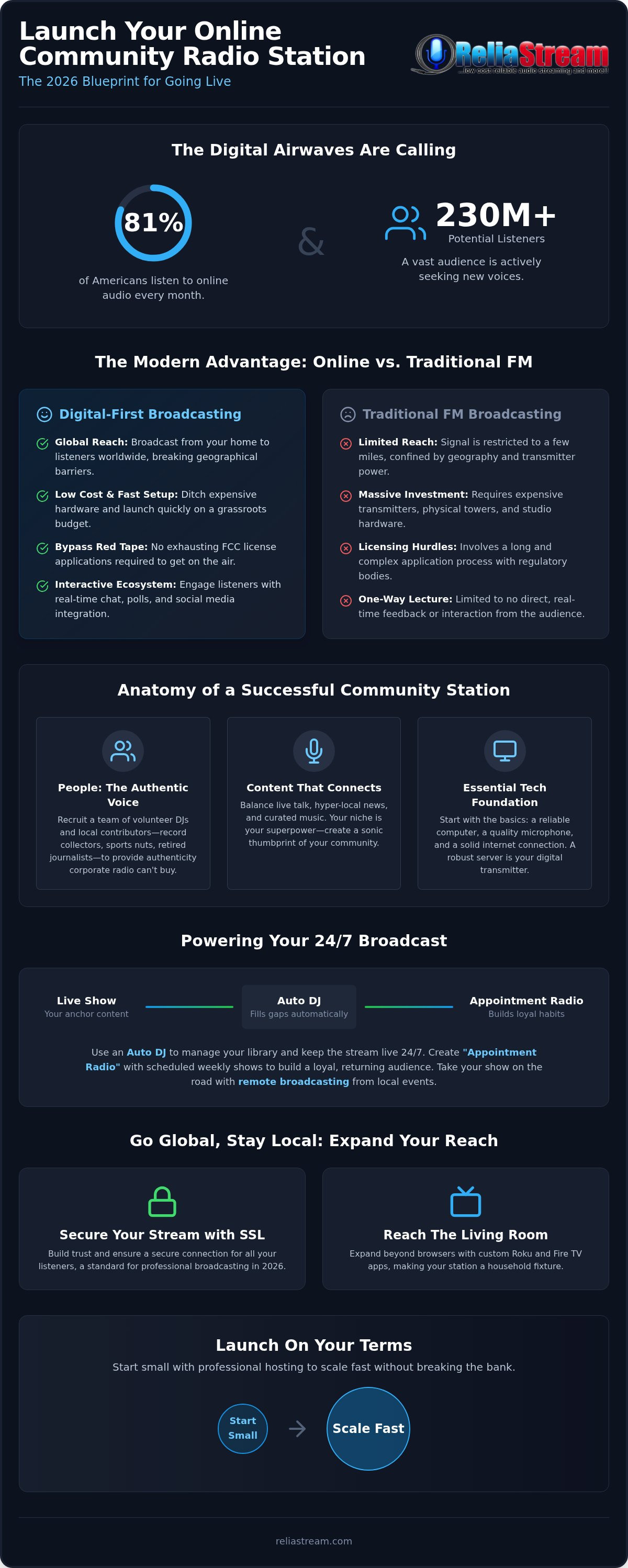
Did you know that 81% of Americans now tune into online audio every single month? That is over 230 million people searching for a voice that actually speaks to them. Building a community radio station online isn't just a hobby; it is the new front porch for local culture. You have stories to tell. Your neighborhood has a beat. But the technical hurdles? They feel like a brick wall. Most creators get stuck on server configurations or the fear of broadcasting to an empty room.
It is time to stop overcomplicating the process. You deserve a clear path to the mic. This guide provides a complete roadmap to launching a professional station with a localized heart. You will discover how to manage your stream with ease, find hosting that fits a grassroots budget, and use smart strategies to build a loyal following. We are stripping away the jargon and focusing on what matters. Let's build your digital town square and get your voice heard across the globe.
Key Takeaways
- Ditch the red tape. Learn why digital-first is the fastest, most affordable way to bypass traditional FM/AM barriers.
- Build a powerhouse team. Master the strategy for recruiting local voices and balancing live talk with curated music.
- Choose your engine. Compare ShoutCast and IceCast to find the perfect technical backbone for your community radio station online.
- Go global, stay local. Secure your stream with SSL and expand your reach into living rooms via custom Roku and Fire TV apps.
- Launch on your terms. See how starting small with professional hosting allows you to scale fast without breaking the bank.
What is a Community Radio Station Online in 2026?
What exactly is a community radio station online in 2026? It is the heartbeat of a neighborhood, digitized. It is a platform where hyper-local news, niche music, and raw dialogue collide. Forget the corporate conglomerates. This is about real people. In a world of faceless algorithms, listeners crave human connection. They want a voice that knows their street, their struggles, and their specific sound. A digital station takes that localized heart and gives it a global reach.
The timing is perfect. Research shows that 81% of Americans now listen to online audio monthly. That is over 230 million people. Even more telling? About 30% of all weekly radio listeners are now tuning into a stream for at least part of their day. The "local frequency" isn't dead; it has just moved. You don't need a million-dollar transmitter or a tower on a hill anymore. You need a vision and a reliable stream. This is the year of the independent voice. The barriers have crumbled, and the microphone is finally yours.
The Core Mission of Digital Community Radio
Community radio has always been about serving the unserved. It gives a microphone to the niche interests that big media outlets ignore. Think about your own town. Who is telling the stories of local artists? Who is covering the school board meetings with actual passion? A digital station prioritizes people over ad revenue. It is non-commercial by nature. It creates a digital town square where your neighborhood or interest group can actually talk back. It is about ownership. It is about identity. It is about giving your community a home in a crowded digital world.
Online vs. Traditional FM Broadcasting
Why go digital instead of traditional? Simple. You bypass the red tape. Traditional FM requires exhausting license applications and massive hardware investments. We are talking about physical equipment that costs a fortune and reaches only a few miles. Going online changes the game completely. Your reach isn't limited by a zip code. You can broadcast from a home studio and reach listeners across the world instantly. Plus, the interactive potential is unmatched. You can integrate real-time chat, instant polls, and social media directly into your broadcast. It is a two-way street, not a one-way lecture. You are building an ecosystem, not just a playlist. It's faster, cheaper, and far more powerful.
Anatomy of a Successful Community Station
A thriving community radio station online isn't just a collection of MP3s on shuffle. It's a living, breathing organism. The secret sauce? People. You need a rotating cast of volunteer DJs and local contributors who bring diverse perspectives to the mic. Recruiting is easier than you think. Look for the local record collector, the high school sports nut, or the retired journalist. These are your anchors. They provide the authenticity that big-budget corporate stations simply can't buy. They give your station its pulse.
Consistency is your best friend. While podcasts are great for on-demand listening, a 24/7 stream creates a shared experience. It builds a "lean-back" habit for your audience. To do this right, you need the right technical essentials. You don't need a massive studio. A reliable computer, a quality microphone, and a solid internet connection are your foundation. Unlike the rigorous FCC application process required for traditional terrestrial broadcasting, the digital route lets you start today. You just need a robust server to handle the traffic. It is about speed and accessibility.
Content that Connects
Your content strategy must balance live talk, local news, and curated music. Big stations ignore the local bake sale or the garage band down the street. You shouldn't. Using talk radio streaming hosting ensures your voice segments are crystal clear; this is vital for building trust with your listeners. Your sound should be a sonic thumbprint of your community. It should feel like home the moment someone hits play. Don't be afraid to get specific. Niche is your superpower.
The 24/7 Broadcast Engine
How do you keep the music playing while you sleep? You use an Auto DJ. This tool is the backbone of any modern community radio station online. It manages your library and fills the gaps between live shows automatically. But don't just set it and forget it. Create "appointment radio" by scheduling specific shows at the same time every week. This builds loyalty. When you're ready to level up, try remote broadcasting. Take your setup to local festivals or high school games. It puts a face to the voice and cements your station as a local fixture. If you're looking for a reliable way to keep that engine running, check out professional hosting options designed for small teams.
Choosing Your Technical Backbone: ShoutCast vs. IceCast
Choosing your server is the most critical technical decision you will make. It's the plumbing of your community radio station online. Get it wrong, and your listeners face buffering, drops, and endless frustration. Get it right, and your voice carries effortlessly across the globe. In 2026, the debate usually boils down to two heavyweights: ShoutCast and IceCast. Both deliver audio, but they do it with entirely different philosophies. One is a battle-tested veteran; the other is a flexible, open-source powerhouse. Your choice dictates how people find you and how they hear you.
Why ShoutCast for Community Stations?
ShoutCast is the industry veteran. It is built for reach. If you want your station to appear in massive public directories where new listeners can stumble upon your stream, this is your tool. It is famously easy to set up. This makes it a perfect fit for stations run by volunteers who aren't necessarily IT experts. You want to focus on the content, not the configuration. Check out the ShoutCast vs IceCast comparison for a deep dive into the technical specifics. It is reliable. It is tested. It simply works.
The IceCast Advantage
Flexibility is the name of the game with IceCast. It is the open-source favorite for a reason. It handles multiple streams, known as mount points, with incredible efficiency. Do you want a high-fidelity stream for home listeners and a low-bandwidth version for people on mobile? IceCast makes that transition seamless. It also offers excellent compatibility with modern web players. This ensures your community radio station online works on every browser and device without a hitch. If you want total control over your technical stack and the ability to scale your streams independently, IceCast is your path forward.
Bitrate matters just as much as the server type. You have to balance audio quality with listener data limits. A 320 Kbps stream sounds incredible on studio monitors, but it will devour a listener's mobile data plan. Most successful community stations find the sweet spot at 128 Kbps. It provides crystal-clear audio without the heavy data tax. For talk-heavy programming, you can even drop to 64 Kbps or 32 Kbps. This ensures your message reaches listeners even in areas with poor internet connectivity. High quality where it counts; accessibility everywhere else. That is how you build a backbone that lasts.
Building Your Audience: Distribution Strategies for 2026
Getting your stream live was the first hurdle. Now? You need ears. A community radio station online lives or dies by its distribution. If people can't find you, you're just talking to yourself. In 2026, the game is played on every device in the house. From the smartphone in their pocket to the smart speaker on the counter. You have to be everywhere. You have to be accessible. You have to be impossible to ignore.
Start by securing the foundation. You must use SSL radio streaming to ensure your station works on all modern browsers. Chrome, Safari, and Firefox will block non-secure streams. Don't let a "Not Secure" warning kill your traffic before it even starts. Secure it. Stream it. Grow it. Once your link is solid, move to the living room. Dedicated Roku and Fire TV apps move your station from a "web link" to a "broadcast channel." It's a massive credibility boost. It's professional. It's the future.
Voice and Smart Speakers
Smart speakers are the new transistor radio. They are everywhere. Imagine a listener in their kitchen simply saying, "Alexa, play [Your Station Name]." That is the convenience factor you need. You can learn how to stream radio on Alexa to capture this massive audience. It's about being where the people are. No tuning dials. No static. Just a simple voice command. It's the ultimate friction-free listening experience for your community.
Visual Radio and Smart TVs
Don't ignore the biggest screen in the house. Putting your station on a Roku or Fire TV app changes the perception of your brand. Custom radio streaming app development allows you to display local weather, album art, and news tickers while the music plays. It's visual. It's engaging. It's professional. It gives your listeners a reason to keep the TV on. It turns your audio stream into a complete multimedia experience.
Drive "tune-in" moments with social media. Don't just post links. Post behind-the-scenes clips. Go live on video while you're live on air. Show the faces behind the voices. Then, nail your local SEO. When someone searches for "radio in [City Name]," your station should be the first thing they see. Use your city's name in your metadata. Be the local authority. Be the digital town square that people actually find. Ready to dominate every device? Get your custom radio app started today and reach your audience where they live.
Starting Smart: Launching on a Community Budget
Think you need a million-dollar studio to go live? Think again. The biggest mistake new broadcasters make is overspending on Day 1. You don't need a soundproofed bunker or a gold-plated mixer. You need a "can-do" mindset and a clear mission. A community radio station online thrives on authenticity, not expensive hardware. Start small. Scale fast. This philosophy keeps you agile and ensures your station survives the first critical year. It's about being lean, mean, and local.
Professional broadcasting doesn't have to break the bank. You can find radio hosting starting at $1.99, which is the perfect entry point for a grassroots project. This allows you to prove your concept without a massive financial risk. Why pay for features you won't use yet? Start with the basics. Build your audience. Then, and only then, invest in the bells and whistles. It's about smart growth, not ego-driven spending.
Maximizing Every Dollar
Efficiency is your secret weapon. Use free, open-source software like Mixxx or BUTT to handle your live encoding. These tools are powerful, community-supported, and, best of all, free. Don't forget the power of the Auto DJ. It keeps your stream alive 24/7 without needing a human in the chair every hour. This reduces your staffing requirements and lets your small team focus on creating killer content. By focusing on budget internet radio hosting, you ensure your station is sustainable for the long haul. Every dollar saved on infrastructure is a dollar you can put back into your local community.
Engaging Your Community for Growth
Your listeners are your investors. Create a "Founding Listener" program to get early financial support. People love to be part of something new. Instead of traditional, cold advertisements, partner with local businesses for "shout-outs." It feels more personal. It builds a partnership rather than a transaction. Turn your listeners into your street team. Encourage them to share the stream on social media. Word of mouth is the most powerful marketing tool you have. It's free. It's effective. And in a tight-knit community, it's everything. Your community radio station online becomes a shared project, not just a service. That's how you build a digital town square that actually stands the test of time.
Claim Your Spot in the Digital Town Square
The microphone is open. The tech is ready. You have seen how easy it is to launch a community radio station online without a massive budget or an engineering degree. By choosing the right technical backbone and expanding your reach through smart speaker skills and custom TV apps, you are no longer limited by a physical zip code. You are building a legacy. You are giving your neighbors a reason to tune in and stay connected. It is about ownership. It is about identity.
Don't let the fear of complexity hold you back. The tools are affordable. The audience is waiting. You just need to take that first step toward the mic. ReliaStream has been the reliable backbone for independent creators since 2008. With a 99.9% Uptime Guarantee and no-nonsense support, we make sure your voice never cuts out when it matters most. Success isn't about having the loudest transmitter; it's about having the most reliable heart. Your community is ready to listen. Are you ready to speak?
Ready to give your community a voice? Start your station for just $1.99 with ReliaStream!
It is time to broadcast. Let's get to work.
Frequently Asked Questions
Do I need a license for a community radio station online?
You don't need an FCC license for a community radio station online, but you do need music royalty licenses. If you play copyrighted music, you'll need to pay organizations like SoundExchange or ASCAP. These fees ensure artists get paid while you stay legal. However, if you only broadcast talk or royalty-free content, your overhead drops significantly. Always check local regulations to ensure your specific content remains compliant. It's about legal safety and professional integrity.
How much does it cost to run a community radio station monthly?
Monthly costs vary based on your listener count and audio quality. Professional hosting plans can start as low as $1.99 per month for basic setups. You also need to budget for your internet connection and music licensing fees. While starting a community radio station online is far cheaper than FM, don't forget small costs like domain registration and website maintenance. Scaling your station is easy as your community grows; start small and invest as you gain momentum.
Can I broadcast from my home for a community station?
Yes, you can broadcast from anywhere with a stable internet connection. Most modern community stations are run entirely from home studios or spare rooms. You don't need a commercial office space to sound professional. As long as you have a quiet environment and the right software, your listeners will never know the difference. This flexibility allows you to recruit volunteers from different neighborhoods to contribute without anyone having to commute to a central studio.
What is the best bitrate for a community radio stream?
128 Kbps is the industry standard for balancing high-quality sound with listener data usage. If your community primarily listens on mobile devices, you might consider a 64 Kbps stream to prevent buffering in low-signal areas. For audiophile-grade music, plans supporting up to 320 Kbps are available. The goal is accessibility. You want your stream to sound crisp without devouring a listener's monthly data plan or causing technical lag on slower home connections. It is about total reliability.
How do I get my community station on smart speakers like Alexa?
You need a custom Alexa Skill or a dedicated streaming app to reach smart speakers. While some directories offer basic integration, a branded Alexa Streaming App provides a much more professional experience. Listeners can simply ask for your station by name. This puts your community voice right in their kitchens and living rooms. It's the modern version of the kitchen radio; convenient, voice-activated, and essential for staying relevant in a digital-first world. It builds real loyalty.
What equipment is essential for a beginner community broadcaster?
A reliable computer and a quality USB microphone are your two most important tools. You will also need a pair of closed-back headphones to monitor your audio without feedback. For software, free encoders like BUTT or Mixxx work perfectly for beginners. You don't need a massive mixing console to start. Focus on voice clarity and a stable connection first. You can always upgrade to professional mixers and XLR microphones as your station grows. Start smart and stay lean.
Can I have multiple people broadcasting from different locations?
Absolutely; modern streaming servers make remote collaboration easy. Multiple DJs can broadcast from different locations by connecting to the same server using unique login credentials. When one DJ finishes their set, the next one can take over the stream seamlessly. This allows your community station to have a diverse lineup of voices from all over the city or even the world. It is the ultimate way to build a truly decentralized digital town square. No limits.
How do I keep my station running 24/7 without being at the computer?
An Auto DJ is the essential tool for keeping your station live 24/7. It allows you to upload your music and scheduled shows directly to the server. When no one is broadcasting live, the Auto DJ takes over and plays your content based on your pre-set playlists. This means your station never goes silent, even when you're asleep. It provides a consistent listening experience for your audience and keeps your on-air presence alive around the clock. Total peace of mind.


