

Free internet radio hosting can get your station on air, but it won’t give every station room to grow. The limitations of free internet radio hosting often include caps on concurrent listeners, bandwidth, storage, bitrate, features, or support. Some free plans allow 1 to 10 concurrent listeners, while others may support up to 25.
Starting with free hosting can make sense when you’re learning, testing a format, or broadcasting occasionally. Before your audience grows, understand which limits could affect listeners and audio quality. This article explains listener capacity and data use, how bitrate affects sound and streaming demands, and when a paid plan may better suit a station with regular programmes or plans to expand.
Key Takeaways
- Identify which hosting limits matter most for your schedule, audience growth, and station assets.
- Choose a bitrate with your desired listening experience and streaming data demands in mind.
- Assess whether a free tier can support your broadcasting routine, tools, and continuity needs.
- Use the article’s practical comparison points to recognize when a paid hosting tier may better fit your station.
Hosting limits such as listening hours, transfer, storage, bitrate, and concurrent listeners
A free plan may limit stream uptime, simultaneous listeners, or the amount of audio delivered. These restrictions can affect sound and scheduling, not just growth.
Bandwidth and Listener Capacity
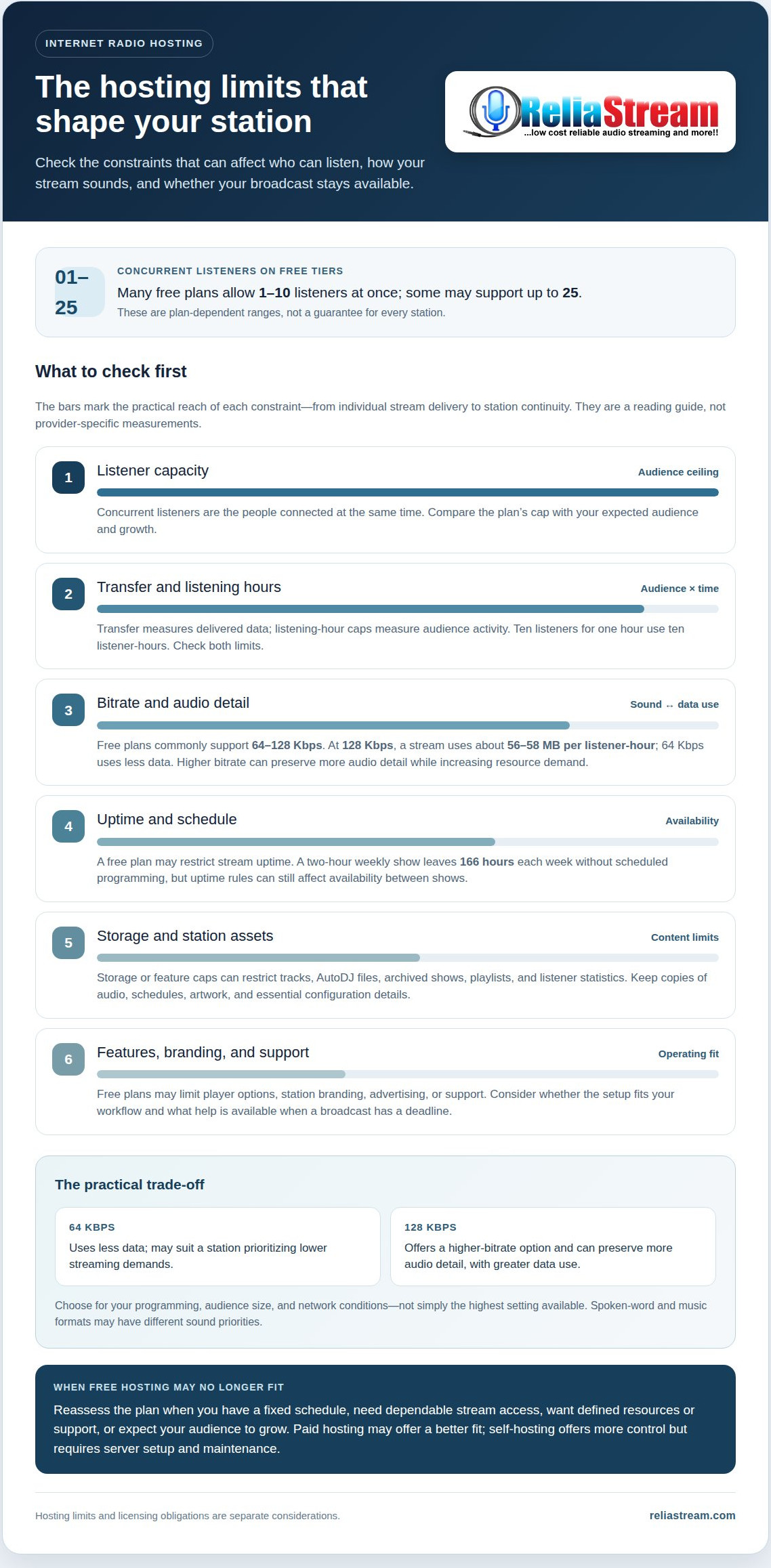
Listener capacity is the number of people who can connect at the same time. Free tiers commonly allow 1 to 10 concurrent listeners, while some free options may support between 1 and 25. Treat these as plan-dependent ranges, not a promise of capacity for every station. Bitrate also matters: a 128 Kbps stream uses about 56 to 58 MB per listener-hour, while 64 Kbps uses less data. The higher the bitrate and simultaneous audience, the more streaming resources the station needs.
Transfer and Streaming Connections
Traditional radio streaming servers create a separate downstream connection for each listener. Ten people listening for one hour use ten listener-hours; a two-hour show with a larger audience uses resources faster than the same show with only a handful of listeners. Transfer limits measure delivered data, while listening-hour caps measure audience activity. Check both, as well as any storage limit for tracks or AutoDJ files. A cap could interrupt your stream or restrict what you can keep online.
Free plans may also limit stream uptime, features, branding, advertising, or support. For example, a two-hour weekly show leaves 166 hours each week without scheduled programming, but a free tier’s uptime rules may still affect whether the stream remains available between shows.
In the United States, music use can involve licensing and royalty obligations. For commercial webcasters, the 2026 SoundExchange minimum is $1,000 per year per station. Hosting limits are separate from those obligations.
Free-plan storage or feature restrictions may affect archived shows, playlists, and listener statistics. Keep copies of audio, schedules, artwork, and essential configuration details so you can move your station if a platform changes its plan or shuts down.
Audio quality and bitrate costs
Free radio streaming plans commonly support audio bitrates between 64 Kbps and 128 Kbps. That range can work for a new internet radio station, but the chosen setting affects sound detail and the data each stream delivers. Higher bitrates carry more audio data, so hosting resource demands can rise as listener numbers grow.
Bitrate describes how much data the stream sends each second. A 64 Kbps setting uses less data than 128 Kbps, while 128 Kbps can preserve more audio detail. The best fit depends on your programming, audience, and network conditions. Spoken-word shows may have different priorities from music formats, where listeners may notice changes in clarity and depth.
Free platforms often cap bitrate, so a station may have to choose within the available range. Hosting can become expensive for audio quality above 192 kbps. Higher quality also requires more data to reach each listener. Consider the trade-off together: target sound, audience size, and available transfer all shape the practical setting.
Your format and encoding software matter, too. Browser-based broadcasting may offer less control over sound quality and fine-tuning than professional broadcasting software. A consistent audio source and suitable encoding settings help keep sound consistent. Test a representative track and a spoken segment before choosing a stream profile, then compare playback on headphones and a mobile connection.
For a station moving beyond a free tier, match bitrate to its programming rather than choosing the highest setting by default. A 64 Kbps stream can help limit data use; a 128 Kbps stream offers a higher-bitrate option. Explore internet radio streaming options as you plan the next step. The right setting balances sound quality with the resources your audience and platform need.
For context, FM has roughly 15 kHz of audio bandwidth before encoding, while AM has roughly 5 kHz. These broadcast bandwidth figures provide a useful reference when considering stream detail, though internet audio is shaped by encoding and bitrate choices as well as the characteristics of the original signal.
Choosing hosting for operational needs
Free hosting can work for testing an encoder, player, or new programme format. The limitations of free internet radio hosting matter more when your station follows a fixed schedule, needs reliable stream access, or plans to grow. Paid hosting can provide defined resources and an operating relationship with a provider. Self-hosting offers more control, but you’re responsible for server setup and maintenance.
Start with your broadcast schedule. A station airing planned shows has different needs from one experimenting with occasional live sessions. Decide whether the stream should run between programmes, whether AutoDJ should play a playlist, and how the encoder will deliver live audio. Rehearsing can reveal workflow problems before listeners expect a programme to start.
Map the signal path from source to audience: encoder, hosting server, stream, then player. Shoutcast and IceCast are streaming server technologies; control panels help manage content and live input. Choose a setup that fits your production process. A solo broadcaster may want a simple workflow, while a team may need tools for coordinating playlists and remote broadcasts.
Continuity matters when listeners expect a show to start on time. An interruption during a live programme can affect a station’s reputation, while a hobby project may tolerate pauses. Support also matters when a broadcast has a deadline. Assess what resources are defined, what support is available, and whether the service offers a practical upgrade path.
Plan for a platform change before you need one. Keep copies of audio, artwork, schedules, playlists, and configuration details. Consider how you would reconnect the encoder and restore the player. These steps reduce reliance on a single platform. The limitations of free internet radio hosting are easier to manage when you can move your station’s core assets and broadcast workflow.
Free hosting provider tiers and their limits
Free plans can differ in more than listener caps. Some also limit station branding, player options, or control over uploaded content. Focus on how those rules affect the listener experience and your ability to move later.
Ads, Branding, and Customization
Some free plans place provider branding or advertising around a station, or limit custom player designs and settings. Restrictions vary by plan. Find out whether the browser player can reflect your station’s identity, whether it can be embedded, and whether a custom domain is supported. These details shape how listeners recognize and return to your stream.
There’s no universal rule for custom domains or embedded players on free hosting. Some plans support them; others restrict these options. Check how the player appears on your station page and whether links would still work if you moved platforms. A podcast archive may need a different presentation from a live stream.
Privacy, Security, and Data Ownership
Consider what the platform stores, including uploaded audio, playlists, and listener statistics. Free-plan terms determine how those assets are handled if the service changes its plans or shuts down. Keep local copies of tracks, artwork, schedules, and configuration details so you have a practical way to move to another host.
Security affects access to both your stream and its management tools. Don’t assume every free plan offers the same protections or controls. Understand how account access works and whether the stream uses a secure link before sharing it widely. IceCast is a streaming server option; the hosting plan determines the tools and settings around it.
For a clear decision, compare each tier’s advertising, branding, player, domain, privacy, and export terms against your station’s needs. If you’re ready to move from a restricted free setup to dedicated radio hosting, explore paid internet radio hosting as your next step.
ReliaStream
ReliaStream provides ShoutCast and IceCast hosting for broadcasters whose audience, schedule, or audio needs have outgrown a free tier. Its 32 Kbps, 64 Kbps, 128 Kbps, and 320 Kbps Hosting Plans offer different bitrate options, helping stations choose a stream level that fits their programming and listeners.
Consider a paid plan when free-plan limits disrupt scheduled shows, restrict stream quality, or make growth harder to manage. Choose based on your station’s sound goals and audience needs, not simply the highest available bitrate. ReliaStream provides ShoutCast and IceCast hosting plans, with Auto DJ, remote broadcasting, and a choice of control panel included.
Contact ReliaStream to discuss your station’s hosting needs.
Build your station around what comes next
The limitations of free internet radio hosting don’t have to define your station’s future. Choose a setup that fits your broadcast plans now and can adapt as your audience changes. As a next step, decide which stream quality and level of operational flexibility matter most for your programming.
ReliaStream offers 32 Kbps, 64 Kbps, and 128 Kbps Hosting Plans, giving broadcasters bitrate options to consider as they move beyond a free tier. The right fit depends on your station’s needs and priorities. Take time to shape a plan around the listening experience you want to deliver.
Contact ReliaStream about radio hosting to discuss your station’s next step. Your broadcast can grow at a pace that works for you.
Frequently Asked Questions
Can I start an internet radio station for free?
Yes, free hosting can help you test a station concept, learn the broadcast workflow, or try a short programme before committing to regular streaming. Start with a simple format and a small playlist, then test how your encoder, stream, and player work together. Treat free access as a starting point, not a guarantee that every feature or operating need will be covered.
How many listeners can I have?
It depends on the free tier’s simultaneous listener cap. Some free hosting tiers allow 1 to 10 concurrent listeners, while free options can range up to 25. Concurrent means connected at the same time, not the total number who can tune in across a day or week. For a planned event, estimate peak audience rather than relying on an average.
Do free internet radio hosts limit streaming hours or uptime?
Some free plans limit listening hours, stream uptime, or both, so an always-on station may not fit every plan. A short scheduled programme and a continuously available stream place different demands on a host. Read the uptime and usage terms alongside the listener cap. Consider, too, what listeners hear if the stream stops between scheduled broadcasts.
What are popular free internet radio hosting services in the United States and their plan limits?
Free hosting tiers differ, so compare their limits rather than assuming one standard U.S. plan. Common constraints include listener capacity, transfer, storage, bitrate, operating time, branding, and support. Free tiers may allow 1 to 10 simultaneous listeners, while some options reach 25. Check whether the plan supports your intended schedule and what happens if you outgrow its limits.


