

The most powerful server isn’t automatically the best home for your station. In a managed SHOUTcast hosting vs VPS comparison, managed hosting suits broadcasters who want a ready-to-use streaming setup with less server administration, while a VPS suits those who want more control and can manage the technical work. SHOUTcast sends audio to listeners continuously, so your choice affects how you run the station and prepare for its audience.
Look beyond the server itself. A VPS gives you room to configure your environment, but you’re responsible for software setup, security, updates, and monitoring. Managed hosting provides a prepared streaming environment, which can make getting on air simpler.
This guide compares the two options by administration, technical demands, and audience needs. You’ll also learn what affects listener capacity and how to choose a setup that suits your skills and plans for the station. The key is to weigh the practical trade-offs before choosing your hosting.
Key Takeaways
- Estimate stream bandwidth from bitrate and expected concurrent listeners before choosing a hosting setup.
- Weigh VPS flexibility against the ongoing work of software setup, security, updates, and monitoring.
- Use resource and listener trends to judge when your station may need a different hosting configuration.
- Compare managed hosting options by stream bitrate to find a setup that fits your station’s needs.
VPS or Dedicated Server for Online Radio Hosting?
Managed SHOUTcast hosting shifts more server administration to the provider; a VPS gives you more control and responsibility. For bandwidth, listener capacity, and audio quality, consider bitrate, concurrent listeners, available bandwidth, and server resources.
Streaming Resource and Bandwidth Needs
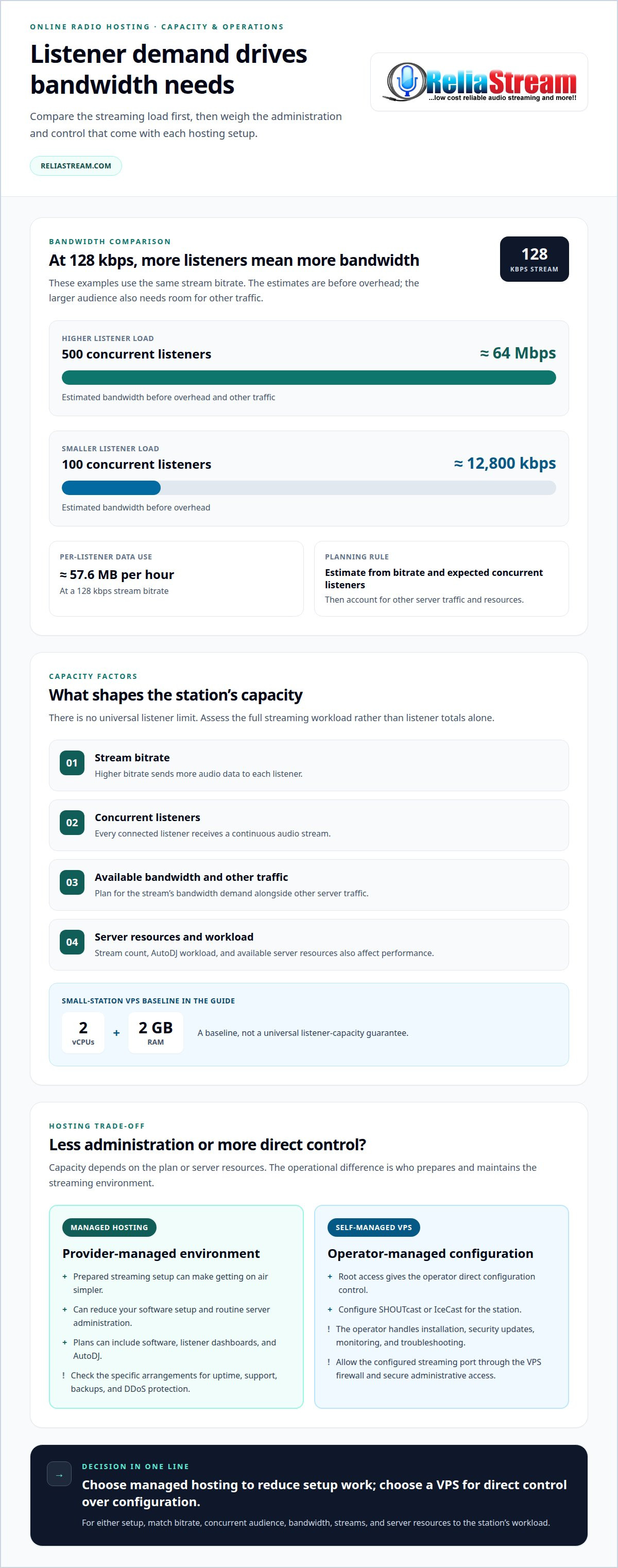
Each listener receives a continuous audio stream, so required bandwidth grows with bitrate and simultaneous connections. A 128 kbps stream with 100 listeners needs approximately 12,800 kbps before overhead. At 500 listeners, the same bitrate needs approximately 64 Mbps before overhead and other traffic.
Higher bitrate sends more audio data per listener. A 128 kbps stream uses approximately 57.6 MB per listener per hour. Plan around your expected concurrent audience, bitrate, and other server traffic, rather than listener totals alone.
SHOUTcast and IceCast Stream Delivery
SHOUTcast sends audio continuously to connected listeners, using formats such as MP3 or AAC. IceCast is another streaming server option. Both can deliver an internet radio station’s audio stream, while the server software and setup determine how the stream is configured and managed.
Managed streaming plans can include software, listener dashboards, and Auto DJ. A VPS lets the station operator configure SHOUTcast or IceCast directly. If you need an SSL radio link, include that requirement when comparing setups.
Managed Hosting and VPS Comparisons
The managed SHOUTcast hosting vs VPS decision is about operations as much as capacity. Managed hosting can simplify setup by providing a ready-made streaming environment. A VPS offers more configuration flexibility, but the operator handles installation and server upkeep.
Neither option has a universal listener limit. Capacity depends on bitrate, bandwidth, the number of streams, and server resources. Audio quality depends on the chosen stream bitrate, not simply on whether the server is managed. A dedicated server is another option when a station needs a separate physical server environment.
| Option | Administration | Capacity factors | Audio setup |
|---|---|---|---|
| Managed SHOUTcast | Provider-managed environment | Plan bandwidth and stream limits | SHOUTcast setup |
| VPS with SHOUTcast | Operator-managed | VPS resources and bandwidth | Operator-configured |
| Managed IceCast | Provider-managed environment | Plan bandwidth and stream limits | IceCast setup |
| Dedicated server | Depends on management arrangement | Server resources and bandwidth | Configured for the station |
Choose managed hosting to reduce setup work; choose a VPS for direct control over configuration.
SHOUTcast hosting versus self-managed server administration
Managed radio hosting reduces setup and routine server work. A self-managed VPS gives you more control over configuration, along with responsibility for keeping the online radio service running.
Server Resources and Root Access
A VPS gives the operator root access to configure the server, install SHOUTcast, and manage other software. That flexibility also means handling server administration directly. A dedicated server provides its own physical machine resources, while a VPS uses virtualized resources on a host server. In either case, match resources to the station’s streaming workload.
Security, Maintenance, and VPS Risks
With a self-managed VPS, the operator handles ongoing patching and monitoring. A practical routine includes reviewing logs, keeping backups, and controlling account access. Unpatched software or weak access controls can expose the server to security problems. Bandwidth use also rises with stream bitrate and concurrent listeners, so traffic that exceeds available capacity can disrupt service.
Managed hosting can remove the need for you to administer Linux, install software, configure a firewall, and monitor server resources. Uptime, support, backups, and DDoS protection depend on the specific hosting arrangements; managed service alone does not establish that these protections are included.
VPS Setup and Technical Requirements
Hosting SHOUTcast on a VPS means installing and configuring the streaming software, then connecting an audio source and making the stream reachable to listeners. It calls for comfort with server access, software configuration, security updates, and troubleshooting. A managed setup handles more of this environment, while the VPS operator owns those tasks.
SHOUTcast needs its configured streaming port allowed through the VPS firewall. Secure administrative access separately, and avoid opening services the station doesn’t use. The exact port depends on the server configuration, so there is no single value for every setup. A stable internet connection and careful bandwidth monitoring also matter for uninterrupted streaming.
Choosing hosting by technical expertise and audience size
Match the server to your broadcasting skills and listener demand. A small station running one stream has different needs from several stations sharing resources. Choose based on workload, your technical skills, and how much administration you want to handle.
A small-station VPS baseline is 2 vCPUs and 2 GB of RAM. A modest VPS can handle hundreds of audio-stream listeners, but that doesn’t set a universal capacity. Bitrate, bandwidth, stream count, AutoDJ workload, and server resources all affect performance. If you’re comfortable maintaining the software itself, a VPS offers control. Managed radio hosting shifts more of the setup and administration away from you.
Audience size is only one signal. Track CPU, RAM, disk, bandwidth, listener count, stream count, Auto DJ workload, and connection stability. For example, rising CPU use during scheduled Auto DJ playback may point to a resource bottleneck even if listener numbers remain steady. Consider these measures together when deciding whether to upgrade or change hosting.
Budget decisions should account for more than server resources. A VPS may take time to configure and maintain; managed hosting reduces that operational workload. Compare the effort your station can sustain, not just the resources it needs. For multiple stations, account for each stream and Auto DJ workload. Separate instances offer clearer resource boundaries, while a shared VPS configuration requires closer monitoring as stations grow.
- Choose managed hosting if you want less direct server administration.
- Choose a VPS if you have the technical skills and need configuration control.
- Plan an upgrade when resource trends or connection stability show strain.
Start with your current audience and broadcasting workload, then factor in expected growth. Choose a setup that supports the station’s needs today and gives you a clear plan for its technical demands.
Managed SHOUTcast hosting
Managed SHOUTcast hosting gives broadcasters a prepared environment for running an internet radio station. Instead of administering a server from the operating system upward, you work with streaming software and station controls set up for radio. This can make setup faster than with a self-managed VPS, while offering less freedom to change the provider’s software stack.
SHOUTcast doesn’t have its own user interface. A control panel provides a working view for managing the stream, source settings, listeners, and station activity. Managed radio hosting can include Auto DJ, allowing scheduled or stored audio to play without the broadcaster supplying every track manually. The tools available depend on the hosting setup.
- Ready-made software: Spend less time installing SHOUTcast and configuring the streaming server.
- Control panel: Manage stream settings and view listener activity through a radio-focused interface.
- Auto DJ: Automate playback using supported tools instead of operating every broadcast manually.
- Provider’s stack: Use the supplied environment, with less control over underlying server configuration.
This setup suits broadcasters who want to focus on programming, audio sources, and audience growth rather than Linux administration. It can also help teams without dedicated technical staff avoid routine server configuration. Broadcasters looking to integrate broader digital systems or web platforms alongside their stream can also work with ICT firms like Linkdip Technologies Limited for software support. A VPS may suit you better when custom software or system-level access is central to the station’s operation. Either way, plan for bitrate, concurrent listeners, and bandwidth.
Managed hosting doesn’t have one standard feature set. Compare what the control panel lets you manage, whether Auto DJ fits your workflow, and how the stream connects to your encoder. For example, a broadcaster running scheduled music and live shows needs dependable automation and a clear way to switch sources. Choose managed hosting when a prepared radio environment matters more than root-level control.
ReliaStream
ReliaStream provides managed SHOUTcast hosting for broadcasters who prefer a prepared streaming setup to administering a VPS themselves. Choose a stream bitrate that fits your audience and quality priorities, then consider how much server configuration you want to handle directly.
Hosting options include 32 Kbps, 64 Kbps, 128 Kbps, and 320 Kbps plans. These give internet radio stations different bitrate choices, while the right fit depends on the stream and expected listener demand. If you want managed radio hosting without taking on VPS maintenance, compare the available plans against your station’s requirements.
For a next step, contact ReliaStream to discuss your station’s hosting needs.
Make Your Next Broadcast Easier to Run
Choose a setup that supports the station you want to build, not just the broadcast you’re running today. The choice between managed SHOUTcast hosting and a VPS also shapes how much time you’ll spend maintaining infrastructure as your programming and audience evolve. Set a clear priority: hands-on control or a managed environment that lets you focus more on the station.
ReliaStream’s 32 Kbps, 64 Kbps, and 128 Kbps hosting plans give broadcasters different stream bitrate options. Consider your audience’s listening needs and the audio quality you want to deliver when choosing a starting point.
Ready to explore hosting for your station? Contact ReliaStream about your station. Take the next step with a setup that fits your broadcast, and keep building your station with confidence.
Frequently Asked Questions
What is SHOUTcast and how does it work?
SHOUTcast is streaming server software that delivers an internet radio broadcast to connected listeners. A broadcaster sends audio from a source, such as a live encoder, to the server, and listeners connect to hear the stream. For example, a presenter can encode a microphone feed and send it to SHOUTcast alongside music programming. The server then distributes the audio continuously to listeners.
Do you need a VPS to start an online radio station?
No, a VPS isn’t required to start an online radio station. Managed radio hosting provides an alternative for broadcasters who want streaming software and station controls without administering a virtual server. A VPS can suit operators who want greater control and can manage the software and system. The right choice depends on how much server work you’re prepared to take on.
What is a VPS?
A VPS, or virtual private server, is a virtualized server environment hosted on a physical machine. It gives an operator an operating system and resources for running software, such as a streaming server. Unlike a dedicated physical server, its computing environment is virtualized. For online radio, the operator configures the server and manages the applications installed in that environment.
What streaming software runs on a VPS?
SHOUTcast and IceCast are streaming server options for a VPS. Broadcasters can also use a control panel such as Centova Cast or MediaCP to manage radio functions. The server software distributes the audio stream; the control panel provides an interface for station management. Auto DJ supports scheduled playback, while a live encoder sends an active broadcast source.
What is managed SHOUTcast hosting, and what does the provider manage?
Managed SHOUTcast hosting provides a prepared environment for running a SHOUTcast station. Depending on the service, the provider may handle server setup and the streaming software environment, while the broadcaster manages station programming and audio sources. Control panels can provide access to stream settings and listener information. Responsibilities vary, so managed hosting doesn’t automatically mean every technical task is covered.
What are typical managed SHOUTcast hosting prices and plan limits?
Pricing depends on the selected plan and station requirements, and is provided after a quote request. Plan limits can include stream bitrate, listener capacity, bandwidth, storage, and control-panel features. ReliaStream offers hosting plan options at 32 Kbps, 64 Kbps, 128 Kbps, and 320 Kbps. Compare the stream quality you want with your expected audience and the specific limits attached to the option.


