

What if a smaller audience is an advertiser’s advantage, not a dealbreaker? If you’re wondering how to start getting advertisers for my radio station, focus on who listens and which businesses want to reach them. A clear audience fit can make your station valuable even when your listener numbers are modest.
It’s hard to pitch airtime when you’re unsure how to describe your audience or set a rate. Advertisers need more than a spot on the schedule. They need a reason to believe your listeners could be potential customers, a clear campaign goal, and a way to see what ran.
This 2026 guide will help you build an advertiser-ready offer, find prospects whose customers match your audience, and present campaign goals and reporting with confidence. You’ll learn what to include in a media kit, how to shape sponsorship options, and how to start conversations with local and niche businesses. A reliable listening experience, whether through a stream or smart TV and Alexa access, can support advertiser confidence too. It’s one part of your offer, alongside audience insight and a campaign you can explain clearly.
Key Takeaways
- Define your station’s format, language, geography, schedule, and listener profile to show advertisers who they can reach.
- Make your media kit easy to scan, and clearly separate measured audience data from estimates and proposed campaign outcomes.
- Getting advertisers for my radio station starts with audience relevance: match prospects and ad formats to listener interests, not just audience size.
- Build trust with a tailored proposal and a clearly scoped pilot that sets out placements, timing, and how you’ll report what ran.
- Make listening and coordination straightforward with accessible stream links, a clear schedule, a smooth creative handoff, and a named contact.
Getting advertisers for your radio station starts with a clear audience story
Advertisers aren’t simply buying minutes on a schedule. They’re looking for a way to reach people who may care about what they offer, in a place or moment that makes sense. That gives an independent station a practical starting point: describe the listeners you can credibly speak about instead of trying to imitate the broad reach of a large network.
Start with five details: your format, broadcast language, geographic focus, schedule, and listener profile. Be specific. “A community station” is a starting point; “a bilingual station featuring local news and music for listeners in the surrounding area” paints a clearer picture, as long as those details reflect your actual programming and audience.
Audience fit is the alignment between a station’s listeners and the people an advertiser wants to reach. Use that principle to steer your pitch toward relevance, not claims that your station reaches everyone. For background on ad formats and the medium, see this overview of Radio advertising.
What should a radio station know about its listeners?
Gather evidence you can support: listening analytics, website activity, app data, and direct listener feedback. Record the source and timeframe for each data point. A dashboard snapshot from one month, for example, is not the same as a year-round audience profile.
Separate measured facts from estimates. Label survey responses or informal feedback clearly, and don’t present them as a complete picture of all listeners. If you don’t have demographic research, describe observable behaviors and programming interests rather than guessing at age, income, or purchasing habits.
Context adds useful detail. Identify whether listeners tune in during a commute, a workday, community events, or specialist programming, but only when your schedule, analytics, or feedback supports that description. Note differences by show or time slot when available. An advertiser may care more about the audience for one program than the station’s overall profile.
How to turn station identity into advertiser value
Your distinctiveness might come from local coverage, a language community, a specialist music format, or a regular show built around a shared interest. Focus on what genuinely sets the station apart. Avoid vague claims like “the whole town listens.” A focused description is more useful and easier to defend.
Next, treat advertiser categories as hypotheses, not proven matches. A station covering local arts might explore a fit with venues, arts organizations, or creative businesses. A specialist program could consider businesses serving people interested in that subject. Check the logic against listener feedback and the prospect’s actual customers before making a pitch.
Build a one-sentence position: “We’re [station or program], serving [supported audience or community] through [distinctive content or listening moment].” For getting advertisers for my radio station, that sentence is a working tool, not a slogan. Use it to guide prospect research, then refine it as you learn which audience details resonate with suitable businesses.
Build a media kit that makes your radio station easy to assess
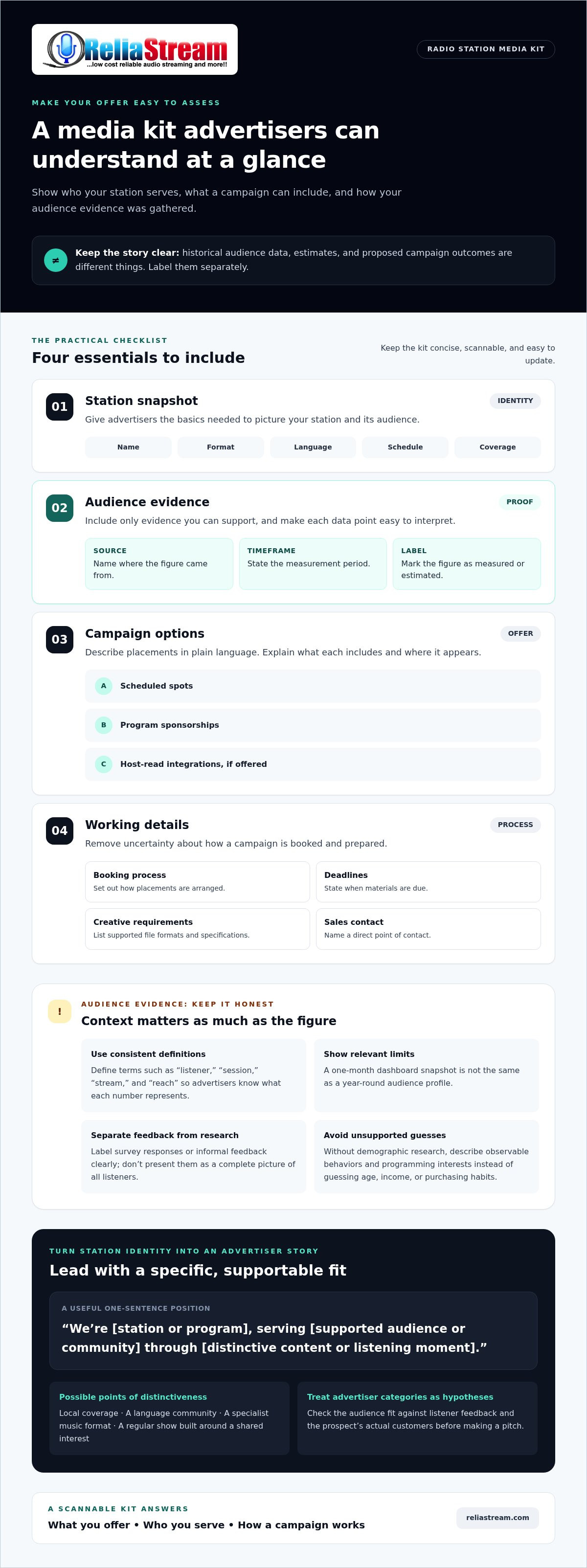
A media kit turns your station’s audience story into something an advertiser can review and act on. Keep it concise, scannable, and easy to update, whether you share it as a short document or a single online page. Lead with your station identity and audience fit, not a long history or a wall of figures. A prospective advertiser should quickly understand what your station offers, who it serves, and how to explore a campaign.
Make the evidence easy to interpret. Mark each audience figure as measured or estimated, name its source and timeframe, and keep proposed campaign outcomes separate from historical data. This distinction makes your offer more credible and helps prevent a forecast or goal from being mistaken for a result you’ve already achieved.
What belongs in an independent station’s media kit?
Give advertisers the essentials: station format and programming, coverage area, listener profile, and the audience evidence you can support. Describe available placements in plain language, such as scheduled spots, program sponsorships, or host-read integrations if you offer them. Explain what each includes and where it appears. Then make the next step clear with booking details, deadlines, creative requirements, and a direct sales contact.
Use a short checklist to make the kit practical:
- Station snapshot: Name, format, language, schedule, and coverage.
- Audience evidence: Figures with sources, dates, and clear labels.
- Campaign options: Placements, scheduling choices, and what the advertiser provides.
- Working details: Booking process, material deadlines, accepted file formats or other creative specifications, and contact information.
Only include creative specifications your station can consistently support. If details vary by placement, say so plainly rather than leaving advertisers to guess.
How to present audience evidence honestly
For every figure, name the analytics source, measurement period, and any relevant limitation. Define terms such as “listener,” “session,” “stream,” and “reach” consistently so readers can tell what each number represents. A stream count, for instance, shouldn’t be presented as a count of unique people unless the measurement supports that interpretation.
Keep channels distinct. Website visits and social followers may show audience interest, but they aren’t automatically radio listeners. Label them as website or social data and explain how they relate to the station, if relevant. Precision builds trust; inflated or ambiguous numbers can damage it.
Include a campaign objective as a goal, not a promise. For example: “Build awareness of the advertiser’s new location among listeners during the station’s weekday afternoon program, then review delivery and advertiser feedback after the campaign.” This identifies an audience context and a way to assess the campaign without guaranteeing sales or response. That clarity is central to getting advertisers for my radio station: offer a measurable plan, then report what actually ran and what you can verify.
A consistent, accessible stream also helps make the proposal feel complete. If you’re reviewing that part of your setup, explore internet radio hosting as one part of a reliable listening experience.
Choose advertisers and offers that fit your station, not just its size
A small audience isn’t automatically a weak offer. If your station serves a clearly defined community or interest, a relevant advertiser may value that connection more than a broad, poorly matched audience. Audience relevance can matter more than raw audience size because a focused group may overlap closely with an advertiser’s customers. The key is to show why the match makes sense without promising sales or responses you can’t guarantee.
Build a prospect list from your format, geography, programming themes, and documented listener interests. A station featuring local arts might research venues, cultural organizations, or businesses that serve arts audiences. A program about a specialist hobby could point toward related retailers or events. Treat these as leads to investigate, not automatic matches. Review each business’s current promotions, audience, and messaging. Then open with a specific observation and a relevant idea, not a generic offer to “buy radio ads.”
How to choose an offer that fits
Different placements involve different levels of commitment from both the station and advertiser. Match the offer to the advertiser’s goal and your team’s capacity to deliver it consistently.
- Scheduled spot: A recorded ad runs in agreed time slots. It suits an advertiser with ready-to-air creative and a clear schedule. Production effort can stay low if the advertiser supplies the approved spot.
- Program sponsorship: The advertiser is associated with a particular show or recurring segment. It can fit a business seeking a consistent connection to that program’s listeners, with repeat scheduling and a defined sponsorship message.
- Promotional integration: The station creates a customized element within programming. This may feel more tailored, but it takes more coordination and production. Agree on the script, approval process, placement, and boundaries before anything airs.
For each option, spell out audience fit, creative workload, scheduling, and reporting. A spot may be easiest to schedule and track by aired placements. A sponsorship needs clear dates and an agreed description of the association. An integration needs additional creative approvals and a report stating what was produced and delivered. Don’t imply that any format guarantees a particular campaign outcome.
Set a rate that reflects the work and scope
Price each proposal around the evidence and work involved, not an arbitrary comparison with a large station. Consider verified audience evidence for the relevant program or time slot, placement frequency and schedule, production requirements, and campaign scope. If evidence is limited, be transparent and offer a tightly defined test rather than dressing estimates up as certainty.
Getting advertisers for my radio station is easier when every offer has a clear fit, defined deliverables, and a sensible way to review what ran. Keep the first proposal focused: one suitable advertiser, one placement type, and a straightforward reason it belongs on your station.
Use a repeatable outreach and campaign process to earn advertiser trust
Good outreach isn’t a mass email with “advertise with us” in the subject line. It’s a relevant idea sent to the right business, followed by a clear plan. For station operators looking to develop their outreach and pitch skills, resources like justgosell.com can offer practical sales training and guidance. A simple process helps you stay consistent without making every pitch feel canned. It also gives potential advertisers a reason to trust what you’ll deliver.
Use this sequence to move from research to follow-up:
- Research the prospect. Review its customers, current promotions, and stated marketing priorities. Look for a specific connection to your station’s programming or listeners.
- Choose one campaign idea. Select a placement that suits the goal and your capacity to deliver it. Keep the first proposal focused.
- Define a pilot. Agree on the audience or program, placement, campaign dates, creative responsibilities, and what you’ll report.
- Confirm the plan in writing. Set expectations for approvals, scheduling, delivery records, and the date you’ll review the campaign together.
- Follow up thoughtfully. If there’s no reply, send a brief follow-up that adds context or clarifies the idea rather than repeating the same pitch.
How to approach a potential radio advertiser
Personalize the opening. Explain why the business fits a particular show or listener interest, then share one relevant audience fact with its source or context. Connect that fact to a goal the business has stated, such as promoting an event or introducing a new service. Close with a low-pressure request to discuss one defined campaign idea, not an open-ended sales meeting.
For example: “I heard you’re promoting your spring workshops. Our station’s weekly gardening program reaches listeners interested in local growing projects. Would you be open to a short conversation about a sponsorship during the next campaign period?” Adapt the details to what you can substantiate. Don’t imply you know more about a prospect’s goals than it has shared.
How to report results and encourage renewals
Before the first placement runs, agree on the objective and indicators you can actually collect. Depending on the campaign, these may include scheduled spots delivered, dates aired, stream or placement records, or response signals the advertiser shares. Keep delivery evidence separate from business outcomes. A campaign report can show what ran; it can’t claim the ad caused sales unless that conclusion is supported.
Send a concise wrap-up with the agreed objective, delivery details, available response signals, and any limitations. Ask what the advertiser learned and what they’d change. Use that feedback to refine a follow-on proposal, whether that means adjusting the schedule, creative, or placement. That’s how getting advertisers for my radio station becomes a repeatable relationship-building process, not a one-time pitch.
A clear campaign also depends on listeners being able to access the stream. To support that part of your setup, explore internet radio hosting for your station’s streaming needs.
Make your station advertiser-ready with dependable streaming and listener access
A compelling offer needs a listening experience that’s straightforward to access and an operations process you can explain. Before a campaign starts, an advertiser should know where listeners can tune in, when the placement is scheduled, who handles the creative, and how you’ll confirm delivery. These basics won’t guarantee campaign results, but they make your station easier to work with and help set clear expectations.
What should be ready before the first campaign?
Run through the listener and advertiser experience before the first placement. Test the stream link on the devices and platforms you expect listeners to use. Check that the schedule, time zone, program details, and advertiser contact information are current. A broken or outdated link can create confusion at the exact moment a campaign is meant to reach listeners.
Set up a simple workflow and document who owns each step:
- Receive: Record the advertiser’s creative, campaign dates, and placement instructions.
- Review: Confirm the material matches the agreed format and campaign plan before scheduling it.
- Schedule: Add the placement to the station’s workflow and share the planned dates with the advertiser.
- Confirm: Keep a delivery record and summarize the campaign evidence you can report afterward.
Name one main contact for campaign coordination, even if a small team shares the work. That person can manage questions, creative handoffs, schedule changes, and delivery updates. Clear ownership prevents details from getting lost between the sales conversation and the broadcast schedule.
How streaming infrastructure supports an advertiser-ready station
Internet radio hosting is part of the station’s delivery setup. ShoutCast and IceCast hosting support online broadcasting, while SSL-secured links provide a secure streaming connection. ReliaStream offers hosting plans with bitrates from 32 Kbps to 320 Kbps, plus control panel options such as Centova Cast and MediaCP for managing features like Auto DJ and remote broadcasting. The right setup depends on how your station operates; infrastructure supports listening access, not guaranteed audience growth or advertising results.
Listeners may also tune in through more than a browser. ReliaStream develops custom radio apps for Roku, Google TV, and Amazon Fire TV, as well as Alexa streaming skills. These can provide additional listening touchpoints when they suit your station’s audience strategy. Make sure the links you share with advertisers and listeners lead to the intended stream, and explain clearly which listening options are available.
For getting advertisers for my radio station, a dependable stream and a clearly managed campaign process help complete the offer. They show that the station has considered both the advertiser’s placement and the listener’s route to the broadcast.
To support your station’s online listening setup, Explore ReliaStream radio hosting.
Turn your next advertiser conversation into a starting point
You don’t need to have every answer before you begin. Choose one promising business, make one relevant proposal, and treat the conversation as a chance to learn what matters to a potential partner. Each response can sharpen how you present your station and where you focus next. Progress comes from steady, credible conversations, not a perfect pitch on the first try.
If your next step is strengthening the listening experience behind your offer, ReliaStream provides internet radio hosting for broadcasters. Explore ReliaStream radio hosting and consider how your streaming setup can support your station’s plans.
Getting advertisers for my radio station is a goal you can move toward one well-matched partnership at a time. Start with the next conversation, stay clear about what you can deliver, and keep building from there. Your station’s audience has a story worth telling.
Frequently Asked Questions
How many listeners do I need to get advertisers for my radio station?
There’s no universal listener threshold that guarantees advertiser interest. For getting advertisers for my radio station, focus on showing why a particular audience is relevant. A program with a modest but clearly described listenership may suit a business serving that interest. State how listening was measured, where the data came from, and the period it covers. Avoid implying that a listener count predicts customer response or campaign results.
Can a small or new radio station get advertisers?
Yes. A new or small station can approach advertisers, provided it’s candid about the data and history it has. Start with a business closely connected to the station’s format or community and propose a limited campaign with clear deliverables. Afterward, ask what the advertiser found useful and record what you learned. Early conversations can help refine your pitch and establish a track record without overstating what the station can prove.
What should I include in a radio station media kit?
Include your format, programming, audience profile, listening evidence, advertising options, schedule details, creative requirements, and sales contact. Add a brief explanation of how a campaign moves from booking to airing so prospects can picture the process. Label every estimate and measured figure, and include its source and timeframe. Keep a dated master copy so outdated schedules or audience figures don’t remain in circulation when you share the kit.
How do I set advertising rates for my radio station?
Build rates around the specific inventory and work involved, rather than copying another station’s card. Account for the placement and schedule, the evidence you can present, any production time, and the campaign’s scope. Make clear what the quoted amount covers, such as the number of placements and creative revisions. If you’re testing a new offer, set a review point so future proposals can reflect actual workload and advertiser feedback.
Should I approach local businesses or national advertisers first?
Start with prospects you can make a credible case for, whether they’re local or national. A nearby business may be a fit if your listeners overlap with its customers; a specialist advertiser may suit a focused program beyond your immediate area. Before pitching, consider where the business operates and whom its current message addresses. Prioritize prospects you can explain clearly, rather than sending the same pitch to a long list.
How can I show advertisers whether a radio campaign worked?
Separate proof of delivery from proof of business impact. You can document when agreed placements aired, then use an advertiser-specific response method, such as a campaign code or dedicated landing page, if both parties agree to it. These signals can help interpret response, but they don’t establish that the ad caused a sale. Share limitations alongside the findings and ask the advertiser what other context may help explain them.
Do I need music licensing to sell radio advertising?
Selling advertising doesn’t itself grant permission to use music. The rights a station needs depend on factors such as its programming and how it distributes content, so don’t assume an advertising agreement or streaming host covers those permissions. Keep the ad-sales plan separate from the station’s music-rights review, and identify the requirements relevant to your operation.


