

Radio hosting with a 99.9% uptime guarantee allows less than 45 minutes of downtime per month under the provider’s stated measurement terms. Uptime is calculated by comparing the time a stream is available with the total time measured, while the guarantee’s terms determine which interruptions count.
A strong uptime figure matters, but it is only one part of dependable radio hosting. Scheduled maintenance, network failures, and outages outside the streaming server can affect listeners, even when a provider’s uptime calculation treats them differently.
This guide breaks down how uptime is calculated and what a 99.9% target means in practice. You’ll learn which reliability factors and provider features matter for internet radio, how to assess service-level terms, and what to compare when reviewing hosting prices and money-back guarantees. The goal is a clearer way to choose hosting that fits your stream, without treating a headline percentage as the whole story.
Key Takeaways
- Read the uptime calculation terms closely: maintenance, network issues, and customer-side problems may be treated differently.
- Match streaming features and bitrate to your broadcast needs, then weigh them alongside reliability and control-panel tools.
- Compare hosting prices by what the plan includes, and read how any money-back guarantee or service credit is claimed.
- Look for a clear service-level agreement that backs its uptime target, not just a headline claim.
Factors affecting hosting reliability
A station’s reliability depends on more than its streaming server. Network routes, scheduled maintenance, software configuration, and the broadcast source all shape what the audience hears. A 99.9% target only tells part of the story; the uptime policy defines which interruptions count.
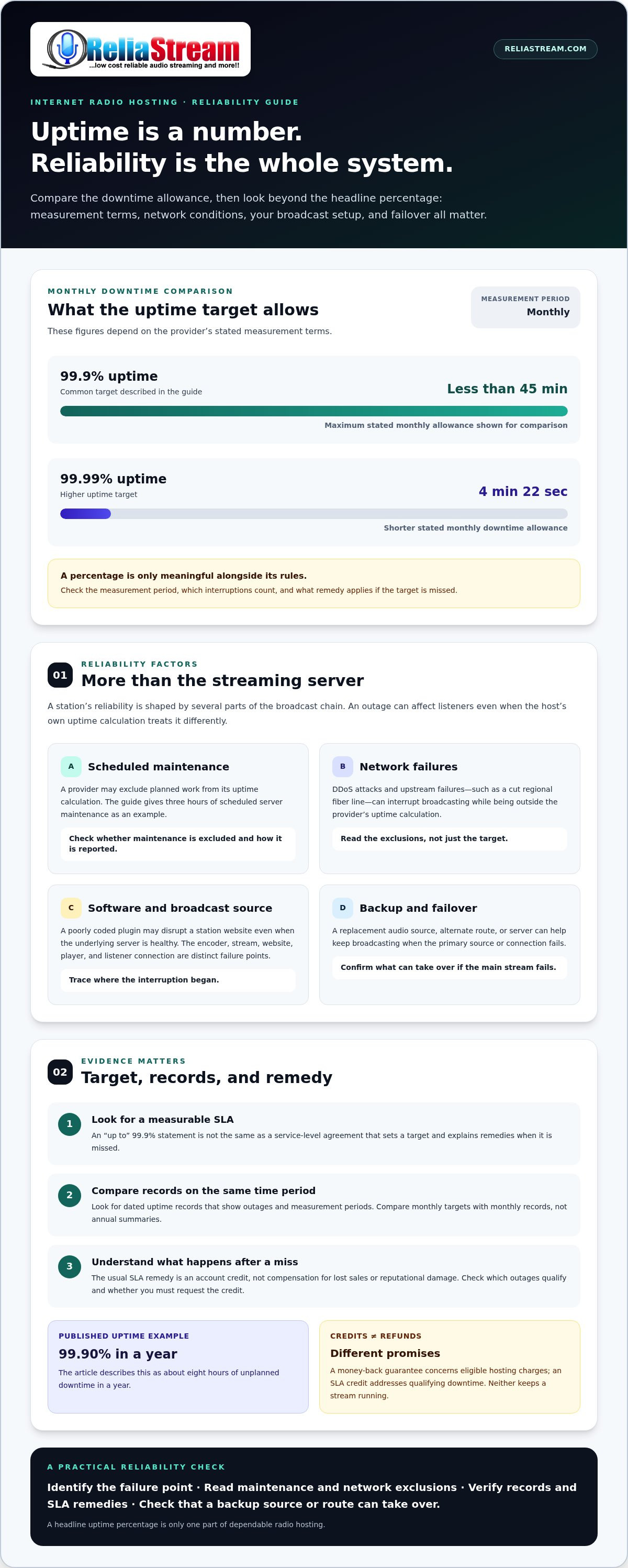
Read the exclusions closely. A provider may exclude three hours of scheduled server maintenance from its uptime calculation. Providers also commonly exclude DDoS attacks and upstream network failures, such as a cut regional fiber line. Those events can interrupt broadcasting even when the hosting platform itself is operating as designed.
Customer-side problems can affect a stream, too. A poorly coded plugin, for example, might disrupt a station’s website while the underlying server remains healthy. A host may treat that outage as outside its uptime calculation. For a ShoutCast station, distinguish the streaming service from the website and player when identifying where an interruption began.
Backup and failover options can reduce downtime by switching the stream to a working source or service when the primary one fails. Keep a backup audio source ready, and plan an alternate streaming route or server so broadcasting can continue if the primary connection fails. The National Institute of Standards and Technology (NIST) advises organizations to ensure external service providers have appropriate failover.
- Trace the failure point: Identify whether the issue affects the encoder, stream, website, or listener connection.
- Review maintenance terms: Note whether scheduled work is excluded and how the provider reports interruptions.
- Assess the backup plan: Confirm that a replacement source or route can take over when the main stream fails.
Compare historical records with the provider’s other customers, then weigh exclusions alongside the headline target. A 99,9% claim means little to a station if its real outage scenario falls outside the provider’s calculation.
Internet radio hosting provider features
Compare the uptime promise, its supporting evidence, and the streaming tools your station needs. A dependable platform makes these details clear before you commit.
Uptime Guarantee Availability
Some internet radio hosts state an uptime target, but “up to” 99.9% doesn’t promise they’ll achieve 99.9%. Look for a service-level agreement (SLA) that sets a measurable target and explains penalties when it’s missed. A 99.9% uptime guarantee corresponds to less than 45 minutes of downtime per month. For comparison, 99.99% allows 4 minutes and 22 seconds monthly. The measurement period matters: compare monthly targets with monthly records, not annual summaries.
Published Uptime Records
Some providers publish historical uptime records or independent monitoring data; availability and reporting formats vary. Look for dated records that show outages and measurement periods, rather than a headline percentage alone. A host recording 99.90% uptime has about eight hours of unplanned downtime in a year. Ask existing customers about their experience, too. Their accounts can add context to published figures, especially when the service supports live broadcasting.
Checking Uptime Before Signup
To assess uptime before signing up, review the provider’s historical records, ask its customers about their experience, and read the SLA’s remedies for missed targets. Check that the target’s period matches the records, then note whether the agreement describes how to claim any compensation. A 99.9% promise backed by clear terms is more meaningful than an “up to” claim without a service-level commitment.
Uptime isn’t the only feature that shapes a listener’s experience. Match stream bitrate to audio needs and audience access: 256 kbps and 320 kbps are examples of higher-quality streams. Check that the platform supports the devices and listening routes your radio stations use. Compare control-panel tools and streaming security as well, so everyday broadcasting fits your workflow. Explore internet radio hosting options as you compare platforms.
Radio hosting prices and money-back guarantee
Compare the hosting charge with the features and uptime terms behind it. A 99.9% target matters financially only when you understand the remedy for missed service.
Hosting Prices
Hosting costs vary with bitrate, listener capacity, server resources, and control-panel features. An IceCast station streaming at a higher bitrate may need a different plan from a low-bitrate broadcast with a smaller audience. Compare plans by their included capacity and features, not just the headline price.
Check whether the fee covers the streaming service you need, along with control-panel and security features. Review the billing period, renewal terms, and charges for optional features. Separating recurring hosting costs from add-ons makes it easier to estimate ongoing expenses and understand what a starting rate includes.
Refunds and Uptime Compensation
If uptime falls below 99.9%, the usual SLA remedy is an account credit, not reimbursement for lost sales or reputational damage. Some providers require customers to request the credit, so the agreement should explain how to submit a claim and which outages qualify. Read the exclusions alongside the credit terms.
A money-back guarantee and an uptime credit are different promises. A refund policy explains whether a customer can recover hosting charges under stated conditions; an SLA credit addresses qualifying downtime. Neither keeps a stream running. Check the policy’s eligibility period, claim deadline, and whether credits apply to future billing.
Use this comparison before choosing an IceCast or other radio server:
- Match capacity: Compare bitrate and expected listeners against the plan’s limits.
- Read the SLA: Find the uptime measurement period, exclusions, and remedy for missed targets.
- Review claims: Note the request process and deadline for credits or refunds.
Even an interruption lasting only seconds can disrupt a live segment. Clear pricing and written compensation terms help you assess financial protection separately from the platform’s technical fit.
Which internet radio hosting providers offer a 99.9% uptime guarantee?
Choose an internet radio host that states an uptime target and backs it with a service-level agreement (SLA). The claim matters only when the agreement defines the measurement period, exclusions, and remedy for missed targets. A search for “radio hosting with 99.9% uptime guarantee” is a useful starting point, but the written terms show what the provider actually commits to.
Providers offering radio hosting with 99.9% uptime guarantee coverage should explain how they measure availability. “Up to 99.9%” doesn’t promise they’ll achieve 99.9%. An industry-standard 99.9% target corresponds to less than 45 minutes of downtime per month. That makes the measurement window essential: monthly uptime and annual uptime aren’t interchangeable comparisons.
A provider’s name alone does not establish reliability. Look for a clear SLA, historical uptime records, and stated penalties for missing the target. Compare the agreement’s exclusions with its remedy: some interruptions may not count toward the calculation, and claiming a credit may require a request.
- Target: Is 99.9% a committed SLA level or only an “up to” claim?
- Evidence: Are uptime records dated and tied to a stated measurement period?
- Remedy: Does the SLA explain qualifying outages and the process for claiming credits?
For a practical comparison, ReliaStream offers hosting plans at 32 Kbps, 64 Kbps, 128 Kbps, and 320 Kbps. Those bitrate choices help match a stream plan to audio needs, but bitrate doesn’t establish uptime. Assess the hosting plan and any uptime commitment separately.
Compare radio hosting with 99.9% uptime guarantee coverage by matching each provider’s SLA with its published records and customer experience. Confirm that the records use the SLA’s measurement period, then read how the provider handles missed targets. That’s a stronger basis for choosing a host than a broad availability claim alone.
ReliaStream: 32 Kbps Hosting Plan
ReliaStream provides internet radio hosting for broadcasters choosing a stream bitrate. The 32 Kbps Hosting Plan can suit a lower-bitrate stream, while the 64 Kbps, 128 Kbps, and 320 Kbps Hosting Plans give stations other bitrate options. Match the plan to your broadcast’s audio needs and listeners’ expected connection quality.
Bitrate and uptime are separate decisions. Review the hosting terms for reliability commitments, then choose a plan that fits your stream. A bitrate does not guarantee uninterrupted broadcasting.
Explore the hosting options or visit reliastream.com to learn more.
Build Your Next Broadcast on a Clear Plan
Turn your reliability priorities into a practical setup for your station. Define what listeners need from each program, which content can run automatically, and how you will communicate if a disruption affects a live show. This gives your hosting decision a purpose beyond comparing uptime claims.
A radio hosting option with a 99.9% uptime guarantee deserves a place in that decision, but make its written terms part of your workflow. Pair your reliability priorities with a bitrate that suits your broadcast. ReliaStream offers the 32 Kbps Hosting Plan, 64 Kbps Hosting Plan, and 128 Kbps Hosting Plan as options for different streaming needs.
Before launch, map your regular broadcast workflow, from preparing audio to starting a live segment. Knowing who handles each step can help your team respond calmly when plans change. It also gives you a clear way to assess whether your hosting setup supports the station you are building.
Ready to align your streaming needs with a hosting plan? Contact ReliaStream about radio hosting and take the next step toward a setup built around your goals. Keep moving forward, and give your next broadcast a strong foundation.
Frequently Asked Questions
How is uptime calculated?
Uptime is calculated by dividing the time a service was available by the total time in the measurement period, then expressing the result as a percentage. Monitoring logs provide the record for that calculation. Before comparing reports, identify whether they track the audio stream, control panel, or entire hosting platform. These measurements describe different parts of a broadcaster’s setup.
What are Internet Radio Hosting Providers?
Internet radio hosting provides the online infrastructure that delivers a station’s audio stream to listeners. Broadcasters connect a live source or scheduled audio to a streaming server, then share a player or stream link with their audience. Services may use platforms such as ShoutCast or IceCast. Hosting handles online stream delivery and related management tools, rather than show production.
What is an uptime guarantee?
An uptime guarantee is a provider’s stated availability commitment for a defined service and measurement period. It typically appears in service terms or a service-level agreement, which should explain how availability is measured and which interruptions are excluded. It does not mean outages are impossible. It sets a target and describes the remedy or service credit that may apply when qualifying downtime exceeds it.
What does a 99.9% uptime SLA guarantee for radio hosting, and what exclusions apply?
A 99.9% uptime SLA sets an availability target for the covered radio hosting service, corresponding to less than 45 minutes of downtime per month. It doesn’t automatically cover every part of a station’s setup. Terms may exclude scheduled maintenance, DDoS attacks, or upstream network failures. Check whether the SLA measures the stream itself, rather than only the server or hosting account.
How much does radio hosting with a 99.9% uptime guarantee cost in the United States?
For U.S. radio hosting, the price depends on the case and is given after a quote request. Key cost factors include stream bitrate, expected listener capacity, server resources, and control-panel features. Compare the service included with the recurring charge, then assess any uptime remedy separately. A lower rate alone won’t show whether a plan fits your station’s stream requirements or reliability needs.
Does a radio hosting uptime guarantee cover scheduled maintenance, outages, and third-party failures?
Coverage depends on the SLA’s exclusions. A provider may exclude three hours of scheduled server maintenance from its uptime calculation, and providers commonly exclude DDoS attacks or upstream network failures, such as a regional fiber cut. A customer-side plugin issue may also fall outside the calculation if the server remains healthy. Read the agreement to see which events count as covered downtime.


