

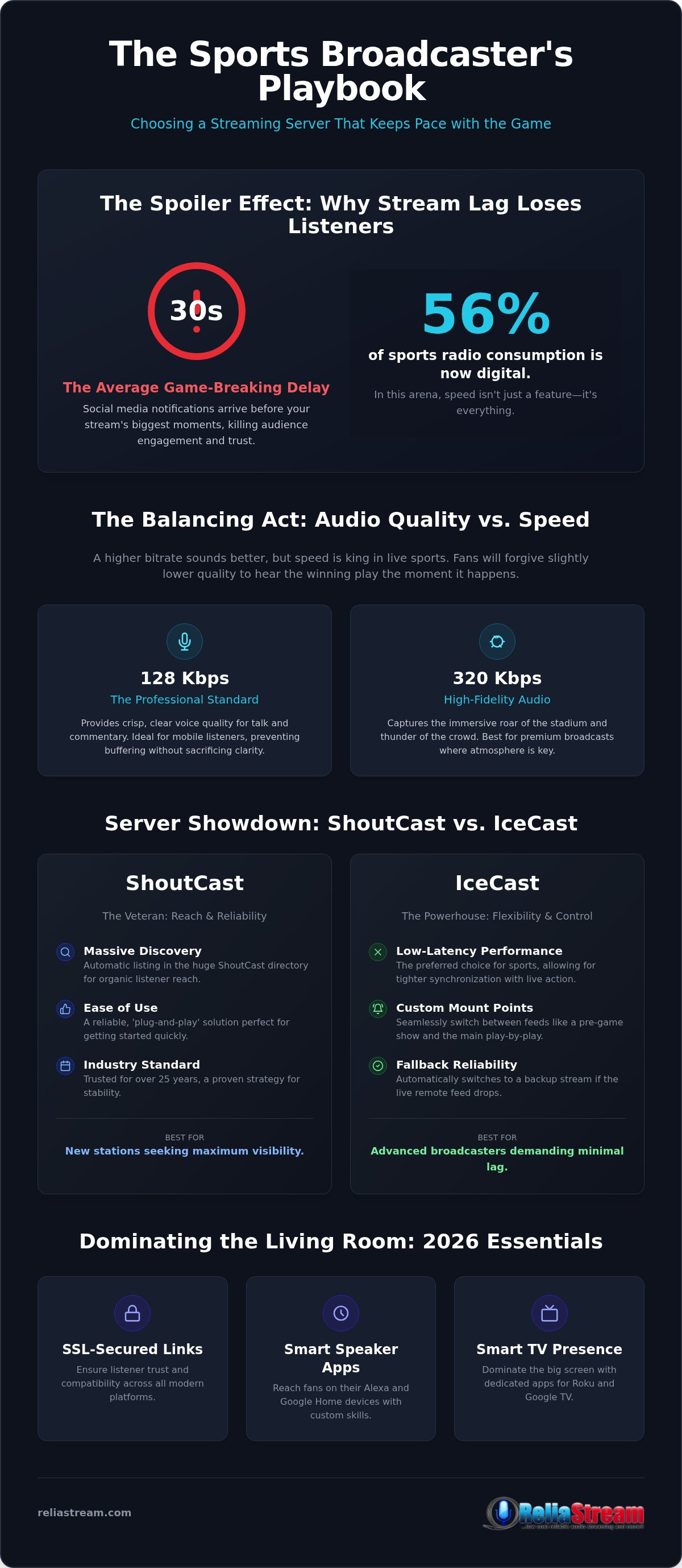
Your listener is leaning in for the final play of the championship. Their pulse is racing. Then, their phone buzzes with a "TOUCHDOWN" notification from social media thirty seconds before they hear the snap on your stream. It's the ultimate buzzkill. In a world where 56% of sports radio consumption is now digital, a laggy broadcast isn't just a minor nuisance; it's a reason for fans to tune out forever. You need a sports radio streaming server that stays in sync with the live action.
We get it. You're tired of server crashes during the playoffs and complex setups that make remote broadcasting a nightmare. You want crystal clear audio that reaches fans on their phones, Alexa, and Smart TVs without the spoilers. This guide breaks down exactly how to choose a high-performance server that handles massive traffic spikes with ease. We'll explore the move to SSL-secured links, the best bitrates for talk versus play-by-play, and the shortcuts to dominating the living room on platforms like Roku and Google TV. Let's get your station up to speed.
Key Takeaways
- Spoilers are the enemy. Learn how to sync your audio with the live action before social media ruins the big play for your fans.
- ShoutCast or IceCast? We break down which MVP server software gives your independent network the ultimate competitive edge.
- Don't let your stream crash in overtime. Discover how a high-performance sports radio streaming server handles massive listener spikes without breaking a sweat.
- Dominate the living room. Find out why SSL-secured links and custom apps for Alexa and Roku are non-negotiable for modern sports broadcasters in 2026.
Why Your Sports Radio Streaming Server Needs Zero-Lag Performance
Sports radio is a different beast. It lives in the moment. Every single second counts. If you're broadcasting a playoff game and your stream is 30 seconds behind the actual play, you've already lost. Your sports radio streaming server is the backbone of your station. If that backbone is weak, your audience will find someone else who can keep up with the score. It is that simple. You aren't just competing with other stations; you're competing with the actual clock.
What does "zero-lag" actually mean in 2026? Technically, absolute zero latency doesn't exist in the world of digital streaming. However, modern standards demand that we get as close to the source as humanly possible. We're talking about narrowing the gap from a 30-second delay down to just a few seconds. Most standard web players add massive buffer time to prevent skipping. For sports, that buffer is a poison. You need a server optimized for raw speed and immediate delivery. This is where professional streaming media systems come into play, providing the infrastructure needed to keep your listeners in the game.
The "Spoiler Effect" and Audience Retention
Audio Quality vs. Speed: Finding the Sweet Spot
You have to choose your weapons carefully. A higher bitrate sounds better, but it demands more from the listener's data connection. For standard sports talk and commentary, a 128 Kbps hosting plan is the professional standard. It provides that crisp, clear voice quality without causing mobile listeners to buffer constantly. If you want to capture the thunder of the crowd and the roar of the stadium in high fidelity, you might push for a 320 Kbps hosting plan. Speed is king in sports. Most listeners will forgive a slightly lower bitrate if it means they hear the winning play the moment it happens. It's about balancing that professional sound with the high-velocity delivery your audience demands.
ShoutCast vs. IceCast: Which is the MVP for Live Sports?
Choosing your sports radio streaming server software is like drafting your starting quarterback. You need a leader that won't choke under pressure. In the world of digital broadcasting, two names dominate the field: ShoutCast and IceCast. Both have their strengths, but when the clock is ticking and thousands of fans are tuning in for kickoff, you need to know which one will hold the line. It isn't just about playing audio. It's about how that audio reaches the ear of a fan sitting in traffic or a listener using a smart speaker at home.
ShoutCast is the veteran on the roster. It has been the industry standard for over 25 years. It is reliable, familiar, and carries a massive advantage: the ShoutCast directory. This directory is a powerhouse for discovery. If you're a new independent sports network, being listed where millions of listeners already browse is a massive win. It simplifies the setup process, making it a great entry point for those who want to get their sports talk show off the ground without a degree in server management. It's a "plug and play" solution that delivers professional results immediately.
ShoutCast for Sports: Directory Reach and Ease of Use
The biggest sell for ShoutCast is visibility. When you use ShoutCast, your station is automatically indexed in their global directory. This means sports fans looking for "local football" or "independent MMA talk" can find you without you spending a dime on marketing. For a small station, that organic reach is gold. The setup is straightforward. You get your server details, connect your encoder, and you're live. If you're looking for a simple way to manage your station, choosing Centova Cast Plans with ShoutCast is a proven strategy for stability.
IceCast for Sports: Customization and Mount Points
IceCast is the flexible, open-source powerhouse that advanced broadcasters love. Its secret weapon? Mount points. In sports broadcasting, you might have a pre-game show running on one feed and the main play-by-play on another. IceCast allows you to switch between these feeds seamlessly. You can set up "fallback" mounts so that if your live remote feed drops, the server automatically switches back to your Auto DJ. This ensures your listeners never hear dead air, even if your stadium Wi-Fi fails. For a deeper dive into the technical specs, check out this ShoutCast vs IceCast Definitive Comparison.
When it comes to the "Live Switchover," IceCast generally has the edge. The ability to move listeners from a pre-game loop to a live broadcast without them having to refresh their player is vital for a professional experience. However, ShoutCast remains the king of simplicity and reach. Both protocols are rock-solid when hosted on a high-performance sports radio streaming server. Your choice depends on whether you value the built-in audience of the ShoutCast directory or the surgical precision of IceCast’s mount points. Either way, you're building on a foundation designed for the long haul.
Managing the Game Day Rush: Stability During Peak Traffic
Sports radio isn't a steady stream. It's a tidal wave. Your Tuesday afternoon might be quiet, but come Sunday kickoff? Everything changes. Fans flood in by the thousands. Your sports radio streaming server has to be ready for that "spiky" traffic. If your server is only built to handle your average daily listeners, it will fold the second the playoffs start. You need burst capacity. You need a backbone that stays rock-solid when the game is on the line and every fan is hitting the play button at once. Don't let a server crash be the reason you lose your audience during the most important game of the year.
Consistency is key. You can't be live every minute of the day, but your station shouldn't be dead air either. A 24/7 Auto DJ keeps the lights on between games. Run pre-game loops. Play post-game analysis. Keep the stadium energy high even when the booth is empty. This keeps your audience engaged and ensures that when a fan tunes in early, they hear your brand, not silence. It's about being a professional, 24/7 sports network, not just a weekend hobby. Your sports radio streaming server should be working for you even when you're away from the mic.
Centova Cast vs. MediaCP for Live Management
How do you manage the chaos? It comes down to your control panel. Centova Cast is the veteran choice. It's all about reliability and rock-solid automated scheduling. It's the "old reliable" that never misses a beat. On the other hand, MediaCP offers a modern, visual interface for broadcasters who want a more intuitive dashboard. Both Centova Cast Plans and MediaCP Plans are designed to handle the most stressful moment of your broadcast: the live handoff. When the whistle blows and you connect your live encoder, the server must transition from Auto DJ to Live DJ seamlessly. No skips. No buffering. Just a smooth handoff that keeps the listeners locked in.
SSL Streaming: Why "Non-Secure" Links Kill Your Reach
Security isn't a luxury anymore. It's a requirement. In 2026, if you aren't using an SSL Radio Link, you're basically invisible. Modern browsers like Chrome and Safari are aggressive. They will block "mixed content" and kill your stream if it isn't secured with HTTPS. You could have the best commentary in the world, but it won't matter if the browser won't let the fan click play. It's a total audience killer. Beyond browsers, smart speakers and mobile apps now demand secure links for compatibility. If you want to be on the devices your fans actually use, you need a secure foundation. Don't fall for the old talk; check out SSL Radio Streaming Myths to see why secure broadcasting is mandatory for any serious sports network.
Beyond the Server: Dominating the Living Room
Your sports radio streaming server is the engine under the hood. It is absolutely essential. It is the core of your operation. But it is only half the battle. To truly win the loyalty of your audience, you have to meet them where they live. Fans aren't just sitting at computers with headphones on anymore. They're in the kitchen prepping for the weekend tailgate. They're in the garage working on the car. They're in the living room with the TV game on mute and your commentary blasting through the soundbar. If your station only exists on a web browser, you're missing out on the prime real estate of the modern home.
Dominating the living room means thinking past the desktop. It means creating a multi-platform presence that makes your station unavoidable. When you make it easy for fans to listen, they listen longer. It's a simple equation. A high-performance sports radio streaming server is the foundation, but the delivery method is what seals the deal. You want to be a part of their daily routine. That starts with the devices they use every single day.
The Alexa Advantage for Sports Fans
Voice control has changed the game for sports radio. When a fan's hands are busy, they aren't going to scroll through a phone to find your stream. They want to bark a command. "Alexa, play my sports network." That immediate access is a massive win for audience retention. A custom skill makes your station the default choice. It builds a habit. Every time they want to hear the latest trade rumors or game analysis, your brand is the one delivering it. If you want to master this technology, dive into the 2026 Alexa Broadcaster’s Guide to see how to get your voice into every smart speaker.
Roku and Fire TV: Your Station on the Big Screen
Why settle for being a tiny icon on a smartphone? Being on Roku or Fire TV puts your independent station in the same league as the massive national networks. It gives you a visual presence in the heart of the home. You can display live scores, highlight your top sponsors, or even show a live video feed of the broadcast booth. This isn't just about audio. It's about authority. When a fan sees your logo on their 75-inch TV, your credibility hits a new level. It transforms your stream from a "hobbyist" feel into a legitimate broadcast powerhouse.
Building this kind of presence used to require a massive corporate budget and a team of developers. Those days are over. Modern Radio Streaming App Development has made it possible for independent creators to launch their own branded apps. Don't let the corporate networks own the living room. Take your space. You can start with a solid foundation and expand into a full Roku Radio App to ensure your station is the center of the fan's sports universe.
ReliaStream: The High-Performance Server for Sports Broadcasters
Stop settling for "good enough" hosting. Your sports network deserves better. You've worked too hard on your commentary and your brand to let a weak server ruin the delivery. You need a sports radio streaming server that matches your hustle. We're talking about high-bitrate plans that go up to 320 Kbps. That is the gold standard for a professional stadium sound. It's the difference between sounding like a hobbyist and sounding like a major network powerhouse. Whether you're just starting out or managing a massive network, there's a plan that fits your budget. From $1.99 entry-level starters to pro-level 320 Kbps bandwidth, we provide the muscle you need to stay on-air. ReliaStream is built on a simple promise: reliable, gritty, and always live.
Why let technical hurdles slow you down? The sports world moves fast. You need a partner that moves even faster. We don't do stuffy corporate talk. We do results. We provide the backbone for independent creators who are hungry to expand their reach and dominate the airwaves. It's about reliability. It's about performance. Most importantly, it's about the fans. They deserve a stream that doesn't buffer when the game is on the line. You deserve a provider that treats your station like the MVP it is. Let's get your voice out there.
Everything You Need in One Place
Why juggle five different vendors? It's a headache you don't need. We handle the hosting, the SSL, the Auto DJ, and the custom apps. It is all under one roof. Our proactive support team understands the urgency of live sports. If you're 10 minutes from kickoff and have a question, you can't wait until Monday morning. You need answers now. We get it. ReliaStream brings over 18 years of veteran expertise to the table. We have been in the trenches since the early days of digital audio. We've seen the industry evolve, and we've helped thousands of broadcasters win their markets. We aren't just a service provider; we're your technical backbone.
Start Your Sports Network Today
Ready to go live? The setup is fast. The results are professional. You can be broadcasting your first game or talk show in minutes, not days. We've stripped away the complexity so you can focus on what matters: the sports. If you're still weighing your options or looking for the best value, check out our Budget Internet Radio Hosting Guide to see how to start smart. Don't wait for next season to start building your legacy. The fans are waiting for a voice they can trust. Launch Your Sports Radio Station with ReliaStream Now!
Take Your Sports Network to the Next Level
You've seen the playbook. You know that zero-lag performance is the difference between keeping a fan and losing them to a social media spoiler. Whether you choose the massive reach of ShoutCast or the surgical precision of IceCast, your sports radio streaming server must be built for the game day rush. It is about more than just audio; it's about stability, speed, and being exactly where the fans are. From the kitchen smart speaker to the living room TV, your station needs a multi-platform presence to survive.
Don't let technical lag hold your vision back. We bring 18+ years of industry expertise to your station, ensuring your broadcast remains rock-solid during every playoff spike. With SSL secure links included and custom Roku and Alexa app development available, we give you the tools to compete with the national giants. Your network deserves a professional foundation that can handle the pressure of live sports.
Get Your Sports Radio Server Running for Just $1.99!
The clock is ticking. Your audience is hungry for real-time action. It's time to stop dreaming and start broadcasting. Let's get you on the air.
Frequently Asked Questions
What is the best bitrate for a sports radio streaming server?
128 Kbps is the professional standard for sports talk. It delivers a crisp, clear voice while keeping the stream stable for mobile listeners on the move. If you want to capture the high-energy roar of a stadium crowd in full fidelity, stepping up to a 320 Kbps Hosting Plan is the way to go. Lower bitrates like 32 Kbps or 64 Kbps work for basic talk, but they won't give you that premium broadcast punch.
Can I broadcast live sports commentary from a stadium using ReliaStream?
You can absolutely broadcast live from the sidelines or the press box. All you need is a laptop or smartphone with a live encoder and a solid internet connection. Connect your encoder to your sports radio streaming server and you are instantly on the air. It's a gritty, "can-do" setup that lets independent broadcasters compete with the big networks from anywhere in the world.
How do I reduce the delay (latency) on my radio stream?
Switching to IceCast is your best move for low-latency performance. Latency usually comes from large buffers in the web player or a slow upload speed at your broadcast site. You can minimize this by optimizing your encoder settings and using a high-performance server designed for speed. The goal is to keep your stream as close to the live game clock as possible so social media doesn't spoil the score.
Do I need a special license to stream sports radio online?
You should always check your local regulations and the specific rights for the sporting events you plan to cover. Every region and league has different rules for broadcasting. While we provide the technical muscle to host your station, you are responsible for the licensing of your content and any music you play. Make sure you have your legal ducks in a row before you hit the airwaves.
Will my sports radio station work on mobile phones and smart speakers?
Your station will work on every modern device as long as you use an SSL Radio Link. Modern browsers and smart speakers like Alexa will block any stream that isn't secured with HTTPS. We provide SSL-secured links to ensure your fans can listen on iPhones, Androids, and Amazon Echo devices without a hitch. If you want to dominate the living room, look into our custom Alexa Streaming App options.
Can I host pre-recorded sports shows and live games on the same server?
You can easily mix live play-by-play with pre-recorded analysis. Use the 24/7 Auto DJ to keep your station active with recorded loops when you aren't at the mic. When the game starts, your live encoder will take over the stream automatically. The server handles the handoff so your listeners never hear dead air or have to refresh their players. It's a seamless transition that keeps the energy high.
What happens if my listener count spikes during a big game?
Your server needs "Burst" capacity to survive the championship rush. Sports traffic isn't steady; it's a massive wave that hits right at kickoff. If your hosting plan isn't built for these spikes, your stream will crash exactly when your fans need it most. We design our infrastructure to handle these surges, ensuring your sports radio streaming server stays rock-solid even when the game goes into overtime.
Is ShoutCast or IceCast better for live sports play-by-play?
IceCast is generally the MVP for live sports because of its flexible "mount points." This technology allows you to move listeners from a pre-game loop to a live broadcast without any interruption. ShoutCast is fantastic for discovery and ease of use, but IceCast offers the technical precision required for zero-lag delivery. Both are reliable choices, but IceCast gives you the edge for advanced live game management.
![Centova Cast Login: Pro Broadcaster's Guide [2026]](https://getautoseo.com/storage/hero_images/centova-cast-login-pro-broadcasters-guide-2026.jpg?v=bbcae8778692)

